Key takeaways
- Google announced Gemini 4 Carbon on October 28, 2026, two weeks after Gemini 4 Argon, calling it its strongest model for cybersecurity and long-horizon work.
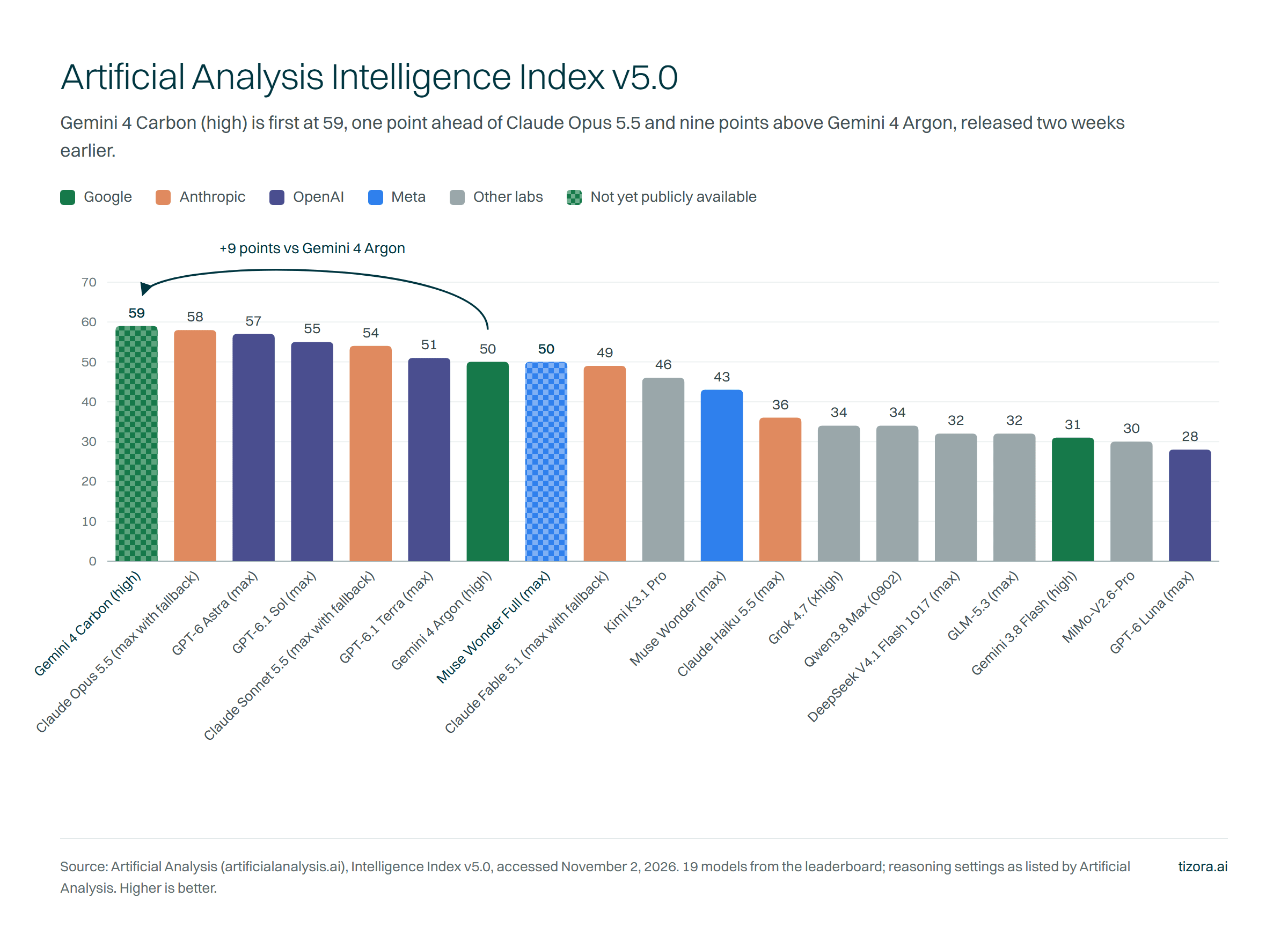
- Carbon is #1 on the Artificial Analysis Intelligence Index v5.0 at 59, one point ahead of Claude Opus 5.5 and two ahead of GPT-6 Astra.
- In Google's 17-benchmark table Carbon has the top score on 15; GPT-6 Astra leads FrontierSWE 2 and Claude Opus 5.5 leads OSWorld-2.1.
- It is not generally available yet: cyber defenders and trusted partners come first, with developers, businesses and consumers to follow at no stated date.
- Introductory pricing is $2 input and $10 output per million tokens, rising to $4 and $20 after the launch period.
Gemini 4 Carbon is Google's newest frontier model, announced on October 28, 2026, just two weeks after Gemini 4 Argon. Google calls it its strongest model for cybersecurity and long-horizon work, and the first independent results back up the headline: Carbon is now #1 on the Artificial Analysis Intelligence Index v5.0 with a score of 59, narrowly ahead of Claude Opus 5.5 (58) and GPT-6 Astra (57). It is also not something most teams can use yet. This guide collects every benchmark published so far, separates Google's own numbers from independent ones, and covers pricing, access and how Carbon compares with the other frontier models.
What is Gemini 4 Carbon?
Gemini 4 Carbon is a large language model from Google DeepMind that builds on Gemini 4 Argon. It was introduced by Koray Kavukcuoglu, Google DeepMind's SVP and Chief AI Architect, who described it as Google's strongest model with state-of-the-art cybersecurity and long-horizon capabilities. Google reports gains in coding, agentic tasks, science, full-stack web development and multimodal understanding, and says that internally it can run for days at a time, persisting through dead ends on long tasks.
What Google has not published matters as much. There is no technical report, no parameter count and no public API specification yet, so claims about its architecture or training are speculation. Everything below is either reported by Google or measured by an independent evaluator, and labelled that way.
| Detail | Gemini 4 Carbon |
|---|---|
| Developer | Google DeepMind |
| Announced | October 28, 2026 |
| Builds on | Gemini 4 Argon (released two weeks earlier) |
| Context window | 1 million tokens |
| Input | Text, image, speech and video |
| Output | Text |
| Price (introductory) | $2 input / $10 output per million tokens |
| Price (standard) | $4 input / $20 output per million tokens |
| Cached input | 95% off the input price |
| Availability | Cyber defenders and trusted partners first; general access not yet dated |
| Technical report | Not published |
Gemini 4 Carbon benchmarks: the full Google table
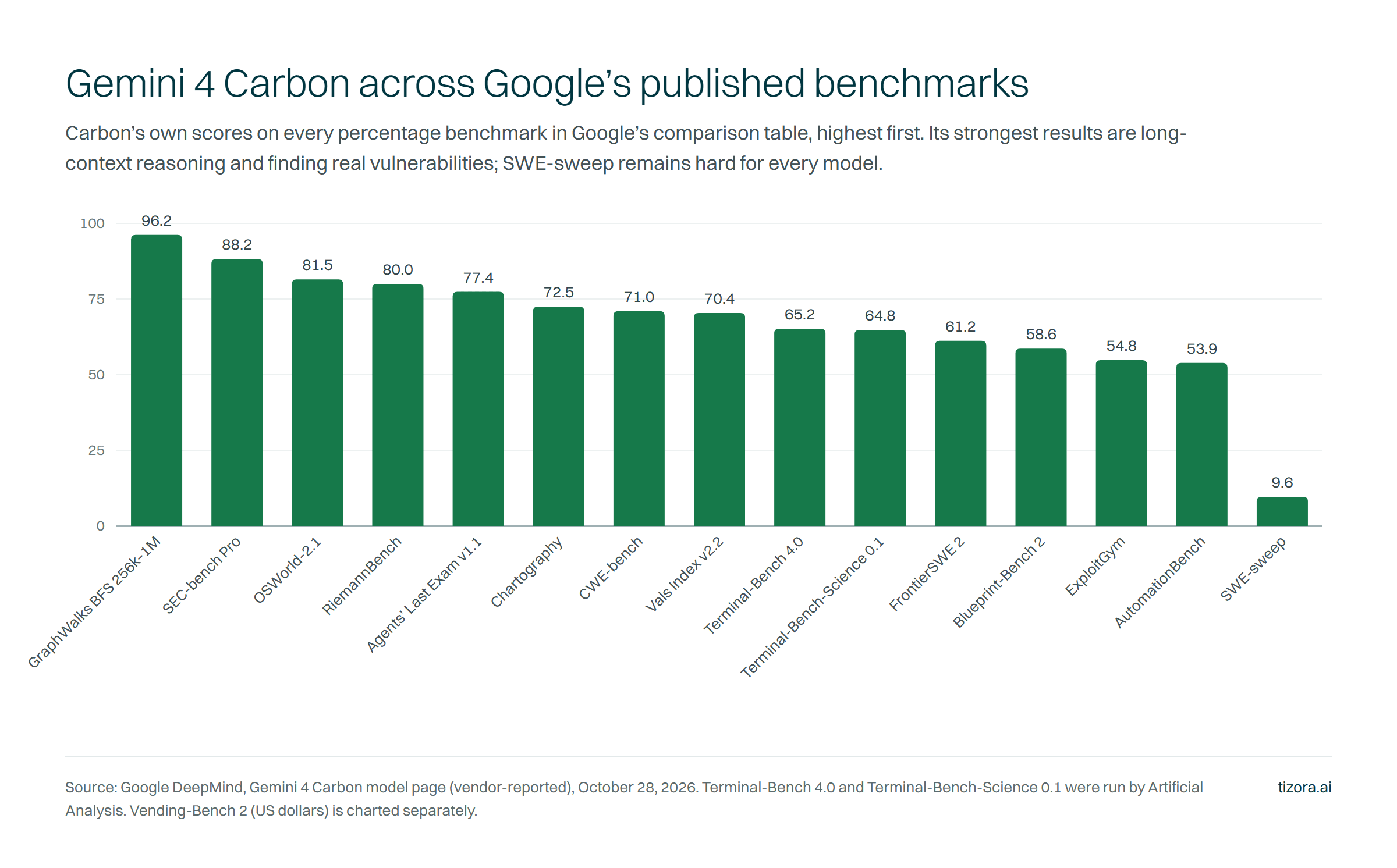
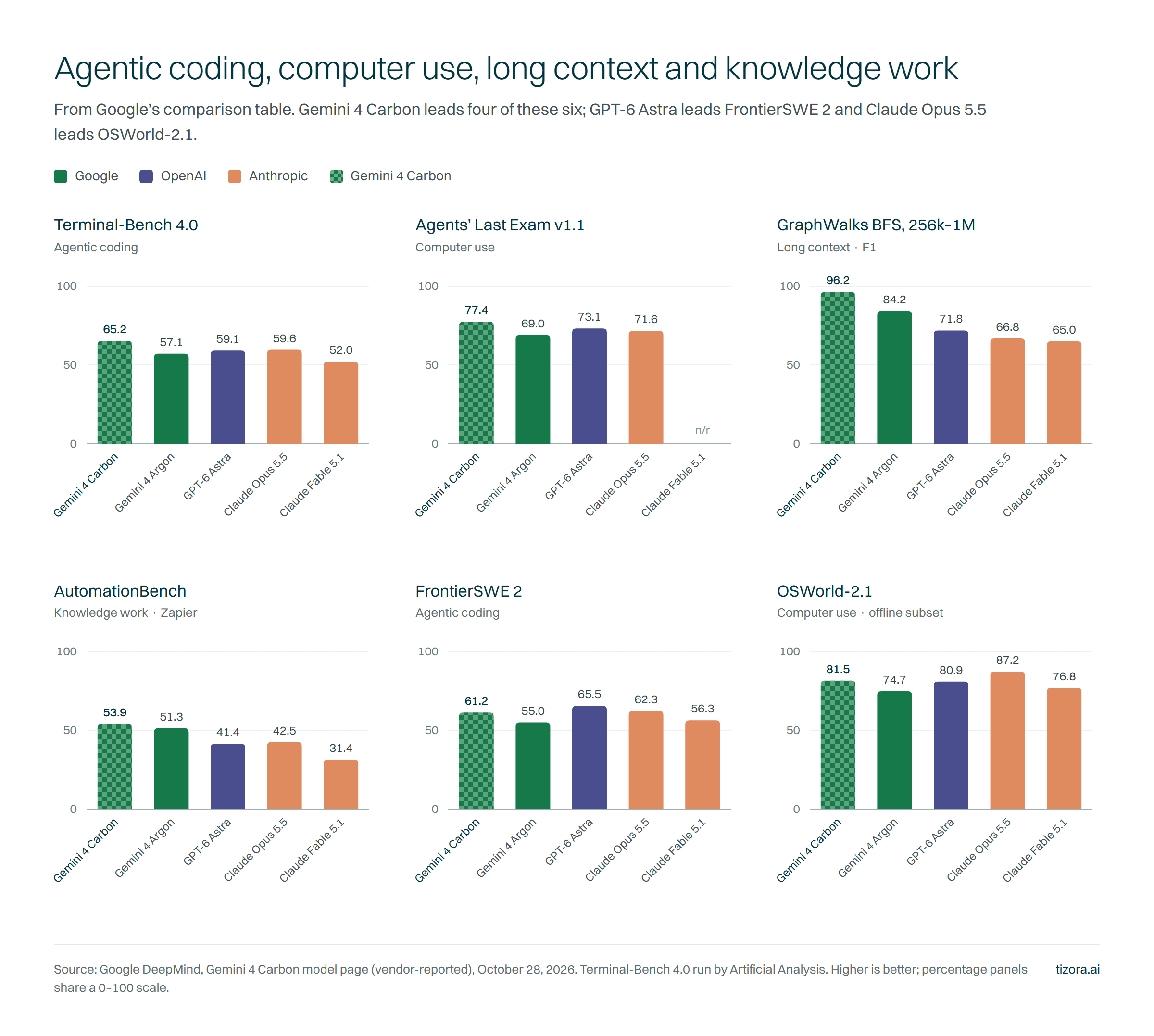
Google's model page compares Carbon with Gemini 4 Argon, GPT-6 Astra, Claude Opus 5.5 and Claude Fable 5.1 on 17 benchmarks across agentic coding, computer use, long context, knowledge work, science and math, multimodal understanding, general capabilities and cybersecurity. Carbon has the highest score on 15 of them. The two exceptions are FrontierSWE 2, where GPT-6 Astra leads (65.5% to 61.2%), and the offline subset of OSWorld-2.1, where Claude Opus 5.5 leads (87.2% to 81.5%).
| Benchmark | Gemini 4 Carbon | Gemini 4 Argon | GPT-6 Astra | Claude Opus 5.5 | Claude Fable 5.1 |
|---|---|---|---|---|---|
| Artificial Analysis Intelligence Index v5.0 | 59 | 50 | 57 | 58 | 49 |
| Vals Index v2.2 | 70.4% | 69.2% | 65.0% | 70.2% | — |
| SWE-sweep | 9.6% | 4.3% | 9.5% | 3.6% | 2.9% |
| FrontierSWE 2 | 61.2% | 55.0% | 65.5% | 62.3% | 56.3% |
| Terminal-Bench 4.0 | 65.2% | 57.1% | 59.1% | 59.6% | 52.0% |
| Agents' Last Exam v1.1 | 77.4% | 69.0% | 73.1% | 71.6% | — |
| OSWorld-2.1 (offline subset) | 81.5% | 74.7% | 80.9% | 87.2% | 76.8% |
| AutomationBench (Zapier) | 53.9% | 51.3% | 41.4% | 42.5% | 31.4% |
| Vending-Bench 2 (bank balance) | $16,484 | $13,718 | $15,515 | $9,235 | $5,422 |
| Chartography | 72.5% | 71.6% | 71.0% | 66.3% | 46.2% |
| Blueprint-Bench 2 | 58.6% | 54.4% | 49.7% | 51.2% | 41.9% |
| GraphWalks BFS, 256k to 1M (F1) | 96.2% | 84.2% | 71.8% | 66.8% | 65.0% |
| RiemannBench | 80.0% | 76.0% | 72.0% | 69.6% | 65.6% |
| Terminal-Bench-Science 0.1 | 64.8% | 52.9% | 63.3% | 59.0% | 43.3% |
| CWE-bench | 71.0% | 68.0% | 68.0% | 67.0% | 58.0% |
| ExploitGym | 54.8% | 42.0% | 42.4% | 34.5% | — |
| SEC-bench Pro | 88.2% | 83.4% | 85.4% | — | — |
Agentic coding, computer use and long context
On Terminal-Bench 4.0, which tests agentic coding in a terminal, Carbon scores 65.2%, about six points clear of Claude Opus 5.5 (59.6%) and GPT-6 Astra (59.1%) and eight points up on Argon. On Agents' Last Exam v1.1, which Google files under computer use, it reaches 77.4% against 73.1% for Astra. The largest gap in the whole table is long context: on GraphWalks breadth-first search across 256k to 1M tokens, Carbon scores 96.2% F1, twelve points above Argon and more than 24 points above Astra.
Carbon is not first everywhere. GPT-6 Astra keeps the lead on FrontierSWE 2 (65.5% to 61.2%), and Claude Opus 5.5 leads computer use on the OSWorld-2.1 offline subset (87.2% to 81.5%). On SWE-sweep every model is still in single digits; Carbon more than doubles Argon (9.6% against 4.3%) but only edges Astra (9.5%).
Knowledge work, science and multimodal understanding
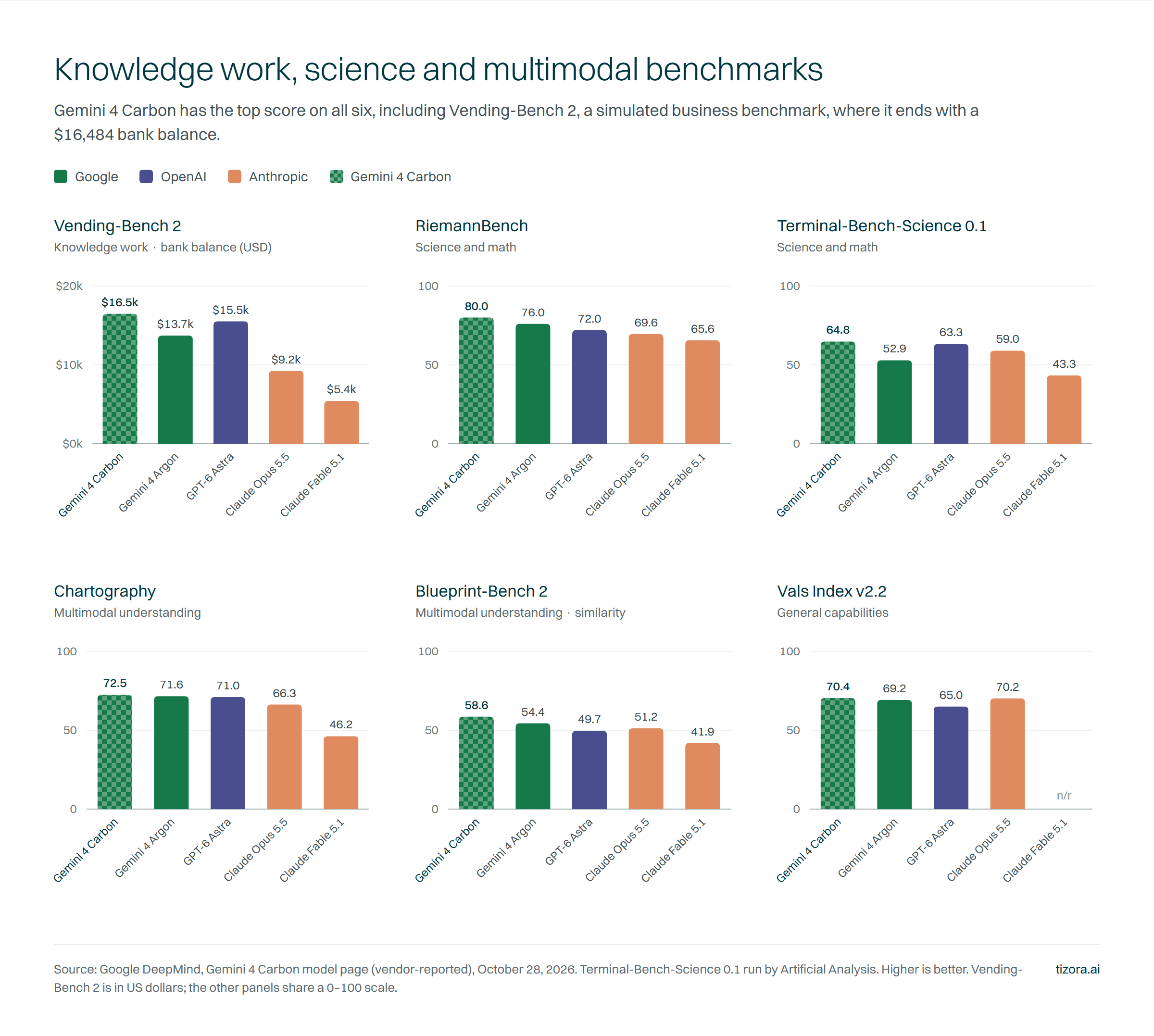
Two benchmarks show the long-horizon work Google is emphasizing. On Vending-Bench 2, a simulated business scored by the final bank balance, Carbon ends with $16,484, ahead of GPT-6 Astra ($15,515) and well ahead of Claude Opus 5.5 ($9,235). On AutomationBench, built with Zapier to test business workflow automation, Carbon scores 53.9%, more than eleven points above Astra and Opus.
In science and math, Carbon scores 80.0% on RiemannBench and 64.8% on Terminal-Bench-Science 0.1, an independent evaluation run by Artificial Analysis. Its multimodal results are closer: on Chartography it is less than a point ahead of Argon (72.5% to 71.6%), and on Blueprint-Bench 2 it leads Argon by about four points.
Cybersecurity: the headline capability
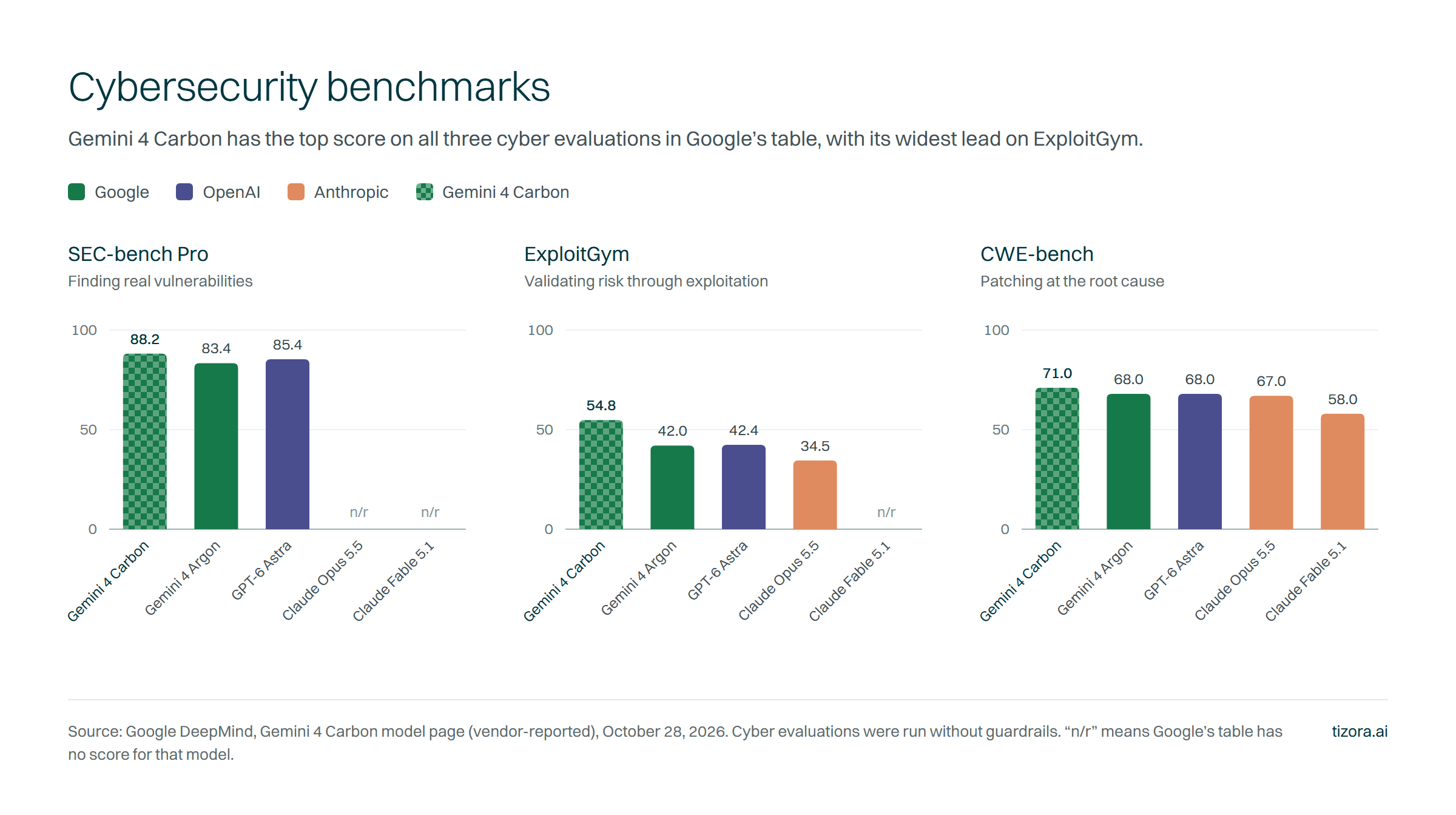
Cybersecurity is where Google is positioning Carbon most strongly, and it is also why access is restricted. Google evaluated the external cyber benchmarks without guardrails. Carbon scores 88.2% on SEC-bench Pro, which Google describes as finding real vulnerabilities in real-world software; 54.8% on ExploitGym, which validates risk through exploitation; and 71.0% on Collinear's CWE-bench, which tests patching at the root cause. The ExploitGym lead is the widest: more than twelve points over both Argon and GPT-6 Astra.
Google also reports results it measured internally, which have not been independently checked:
- Secure code: more than twice the secure-code uplift of Gemini 4 Argon.
- Patches: Google's Chrome team rated Carbon's patches more than ten times better than those of another lab's model, which Google did not name.
- Prompt injection: a 0.0% attack success rate on Gray Swan's Indirect Prompt Injection benchmark, down from 0.7% for Argon, which previously led it.
- Penetration testing: Google cites testing by Wiz in which Carbon leads on web penetration testing; no score was published.
For security teams this cuts both ways. A model that finds, exploits and patches vulnerabilities this well is useful to defenders and attractive to attackers, which is why Google is giving cyber defenders access first. It also raises the bar for anyone shipping AI features: model-level resistance to prompt injection does not protect the tools, data and permissions around the model. An AI security assessment tests that whole system, and application security testing covers the software the model is wired into.
What independent benchmarks say
Artificial Analysis, which runs its own evaluations, places Gemini 4 Carbon (high reasoning) first on its Intelligence Index v5.0 at 59. Claude Opus 5.5 (max) scores 58, GPT-6 Astra (max) 57, GPT-6.1 Sol (max) 55, and Gemini 4 Argon (high) 50, so Carbon is nine points up on a model released two weeks earlier. Carbon is #1 on four of the nine evaluations in the index: HLE-Diamond, Terminal-Bench-Science, AA-Omniscience and AutomationBench-AA. Artificial Analysis also notes the model is not yet publicly available.
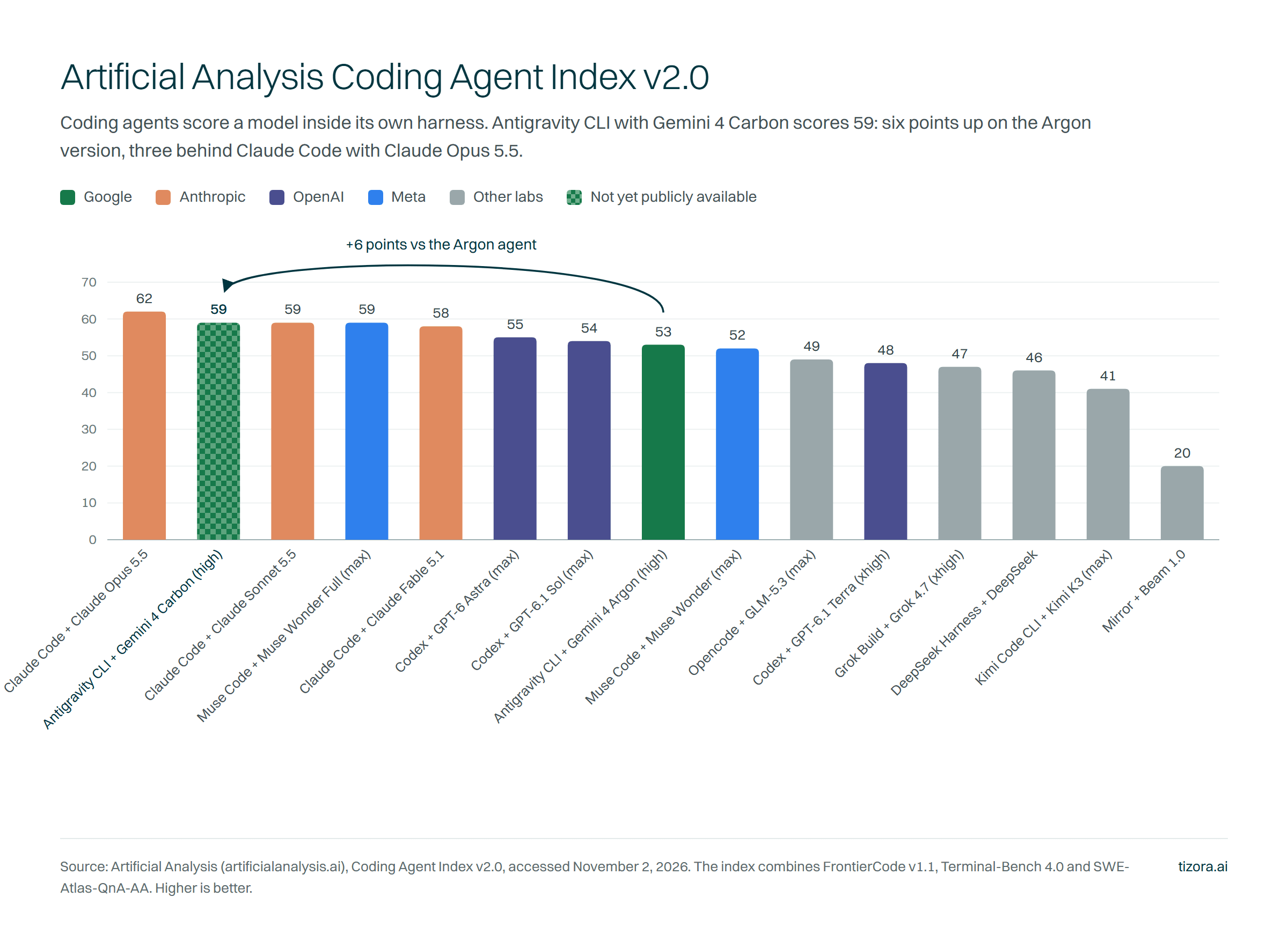
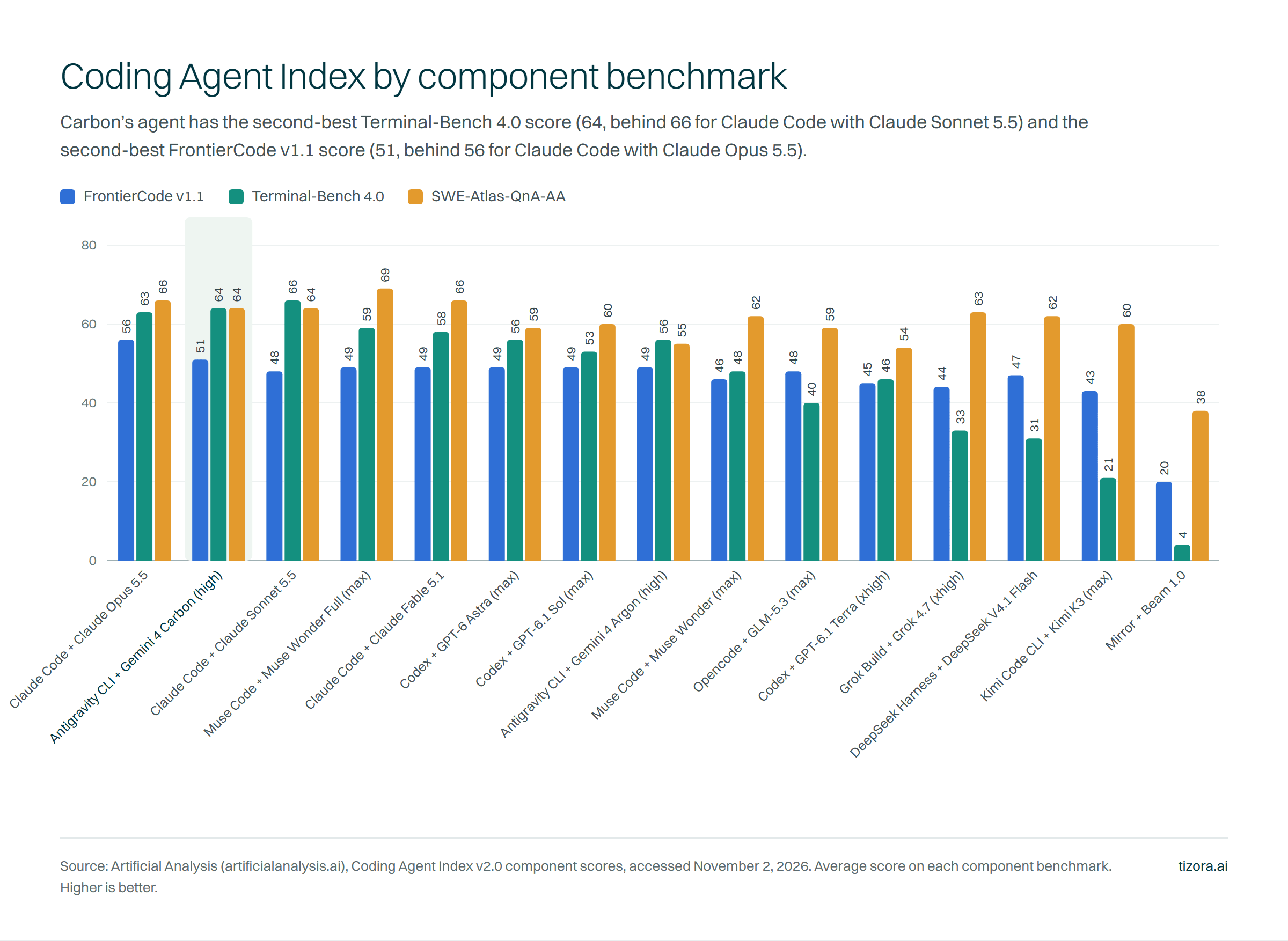
Coding agents tell a closer story. The Artificial Analysis Coding Agent Index v2.0 scores a model inside its own agent harness, combining FrontierCode v1.1, Terminal-Bench 4.0 and SWE-Atlas-QnA-AA. Antigravity CLI running Carbon scores 59, six points up on the Argon version but three points behind Claude Code running Claude Opus 5.5 (62), and level with Claude Code running Claude Sonnet 5.5 and Muse Code running Muse Wonder Full.
On AA-Omniscience v1.1, Carbon scores 54, six points ahead of Claude Opus 5.5 and eight ahead of Argon. Its accuracy rises ten points over Argon to 58%, but its hallucination rate also rises, from 4% to 11%. Artificial Analysis notes that is still the second-lowest rate of any model it has measured, behind only Argon.
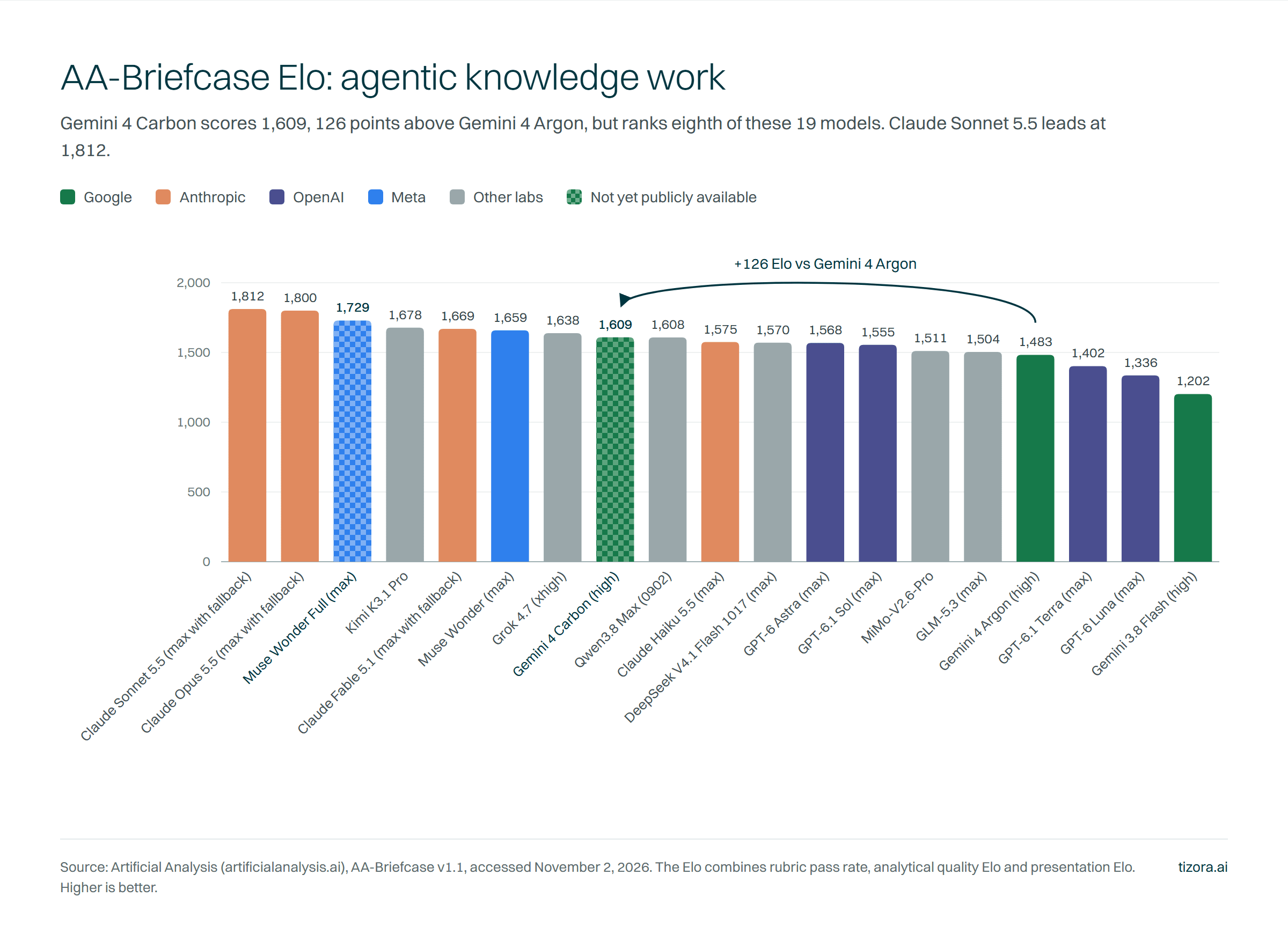
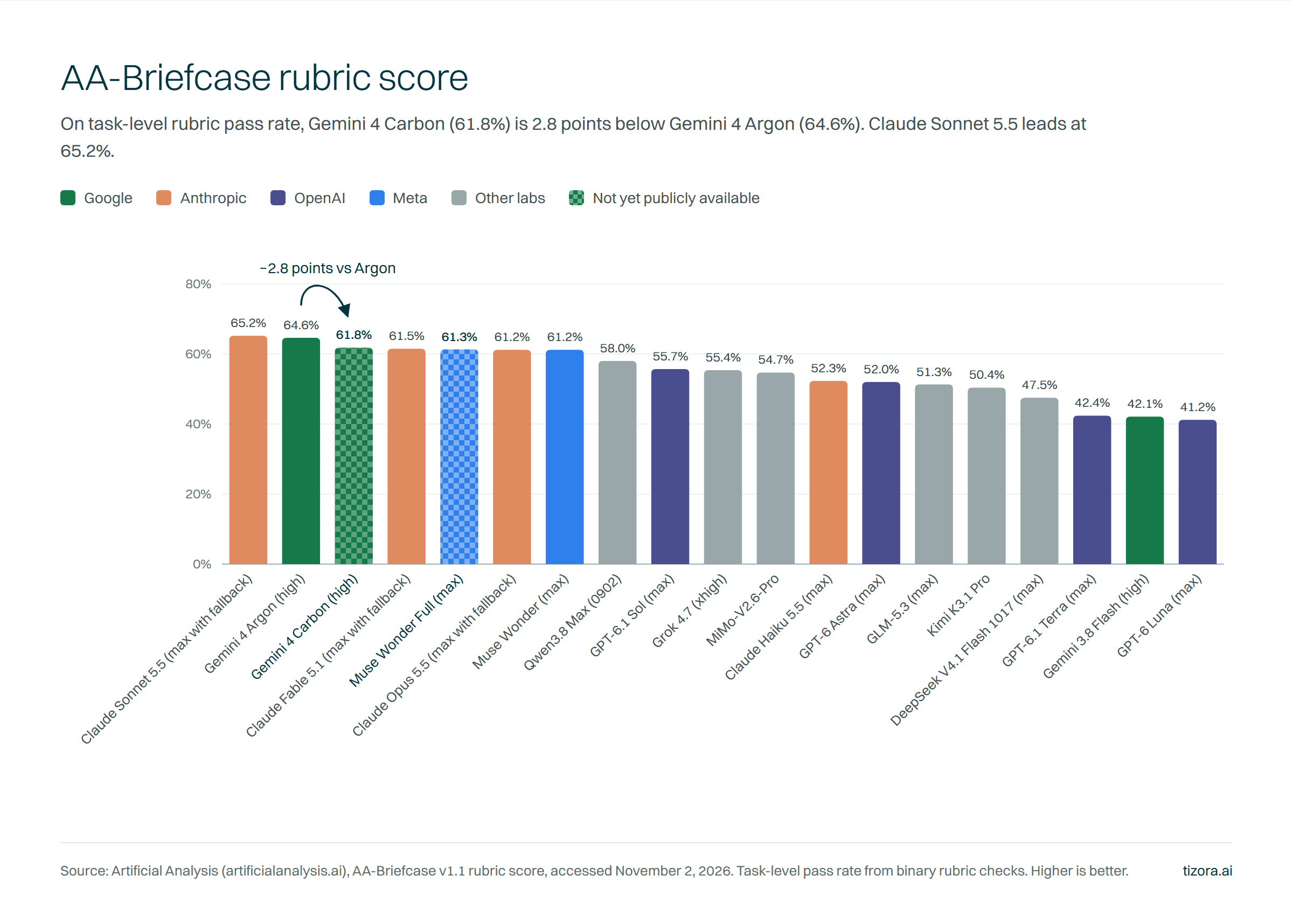
Not every independent test puts Carbon first. On AA-Briefcase v1.1, Artificial Analysis's agentic knowledge-work benchmark, Carbon's Elo of 1,609 is 126 points above Argon but ranks eighth of the 19 models shown, behind Claude Sonnet 5.5 (1,812) and Claude Opus 5.5 (1,800). On the same benchmark's rubric pass rate, Carbon (61.8%) actually scores 2.8 points below Argon (64.6%).
Vals AI, another independent evaluator, ranks Carbon second of 32 models on its Vals Index at 70.45%, just behind Claude Sonnet 5.5 at 70.85%. Within that index Carbon is first on the Vals Finance Index (67.05%) and on Legal Research Bench (55.77%), and fourth of 59 on Terminal-Bench 4.0 (63.13%). Vals puts its cost at $10.51 per test.
Gemini 4 Carbon vs GPT-6 Astra vs Claude Opus 5.5
Across the benchmarks the three labs have in common, Carbon leads more often than not, but the margins are small at the top and the leader changes by task. Choose by the workload you actually run, not by the overall index. For background on OpenAI's model, see our analysis of GPT-6 Astra.
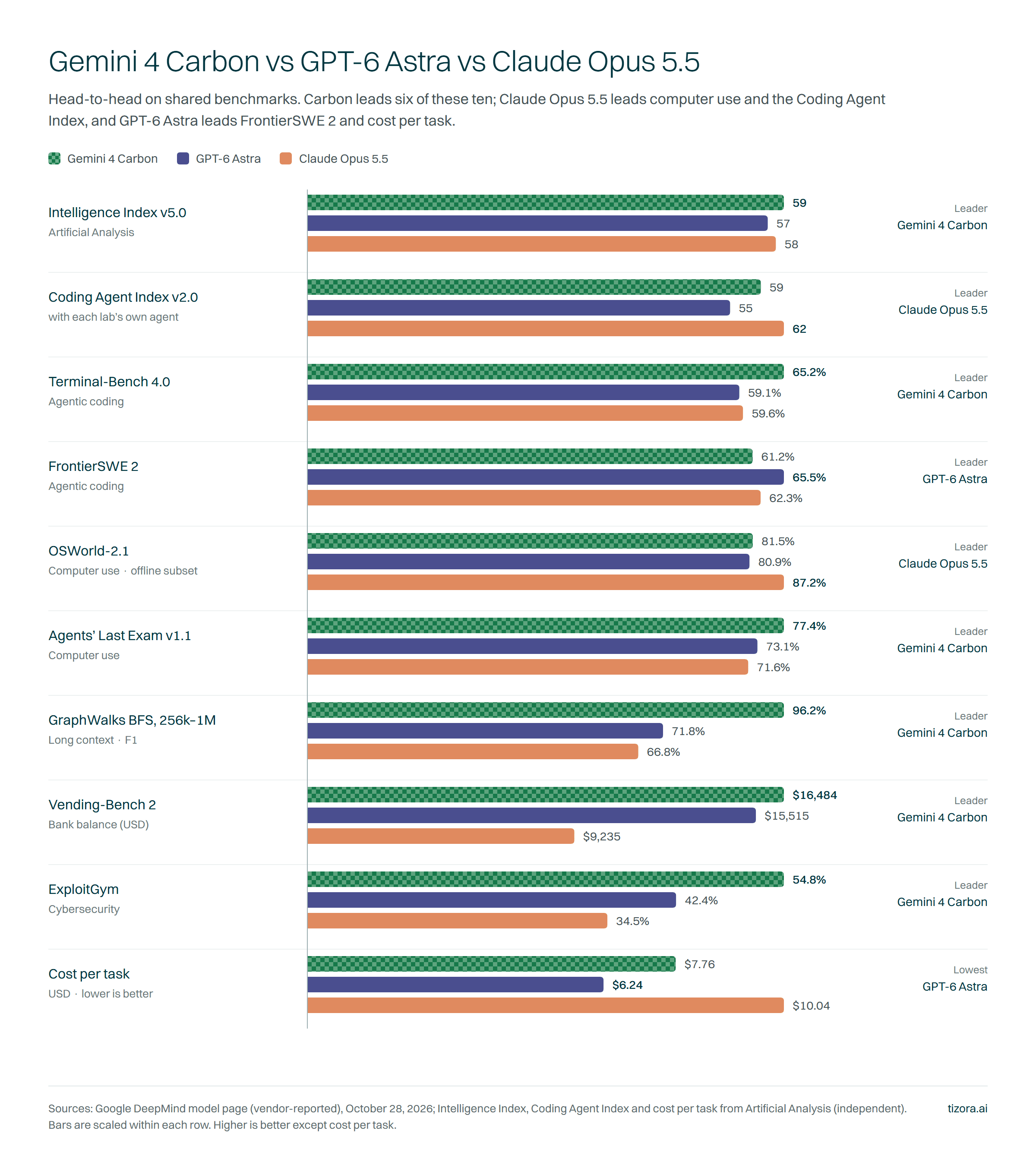
- Pick Gemini 4 Carbon for long-context reasoning over very large inputs, long-running agent tasks, workflow automation and security work, once you have access.
- Pick Claude Opus 5.5 for computer use and coding-agent work today: it leads OSWorld-2.1 and, inside Claude Code, the Coding Agent Index.
- Pick GPT-6 Astra for software engineering on FrontierSWE 2 and a lower cost per task than Carbon at standard pricing, with general availability.
Gemini 4 Carbon pricing and cost per task
Google lists introductory pricing of $2 per million input tokens and $10 per million output tokens, with cached input 95% cheaper. After the introductory period the price rises to $4 and $20. Artificial Analysis describes the introductory rate as a 50% launch discount with no confirmed end date, and uses the $4 and $20 standard price in all of its charts.
| Price | Input | Output | Cached input |
|---|---|---|---|
| Introductory | $2 | $10 | 95% off input |
| Standard (after the introductory period) | $4 | $20 | 95% off input |
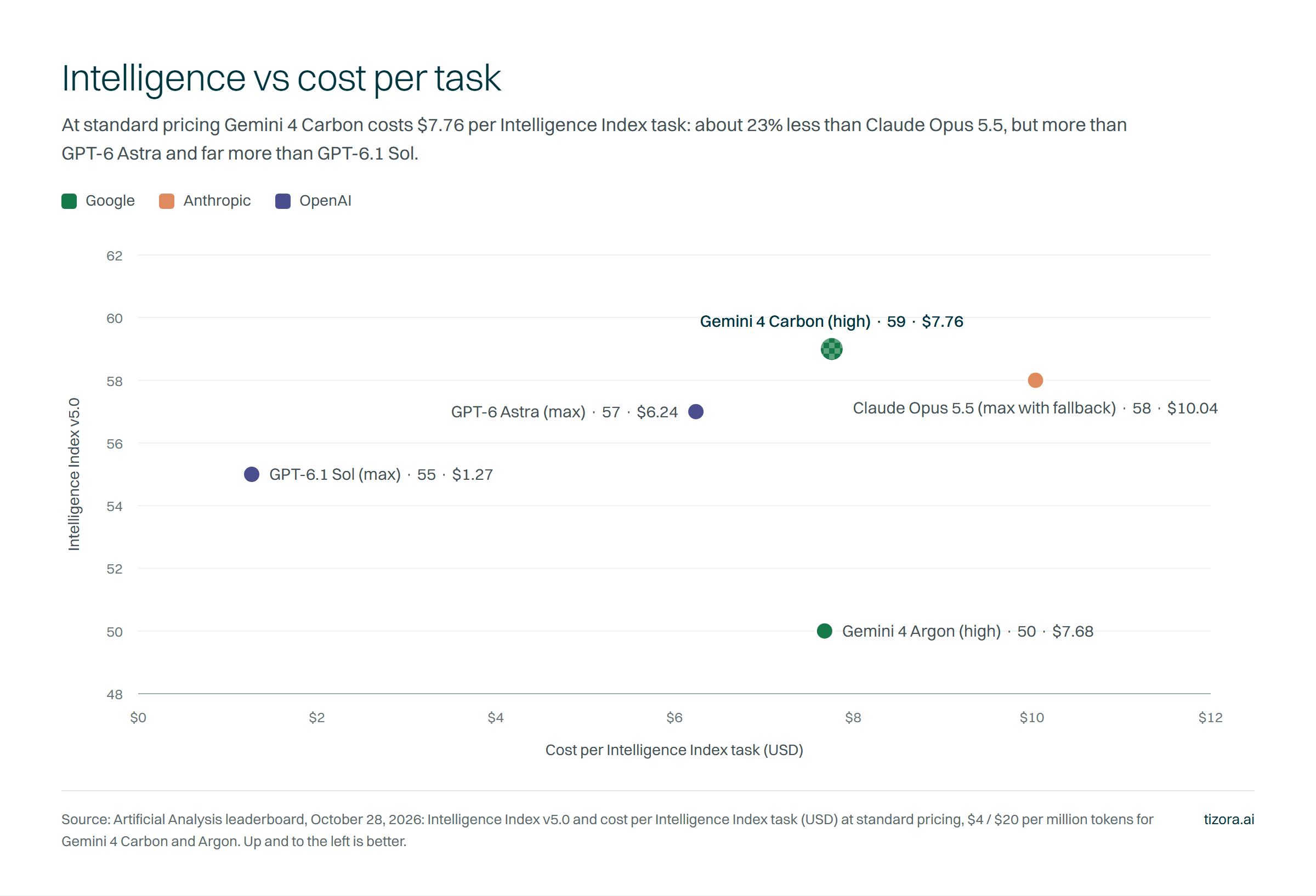
Per-token price is only half of the cost. At standard pricing Artificial Analysis measures $7.76 per Intelligence Index task for Carbon, about 23% less than Claude Opus 5.5 ($10.04) but more than GPT-6 Astra ($6.24) and far more than GPT-6.1 Sol ($1.27). Part of Carbon's advantage over Opus is efficiency: it uses 123k output tokens per task, 29% fewer than Opus 5.5's 173k. Argon, at the same standard price, costs $7.68 per task, so Carbon's nine-point gain comes at almost no extra cost per task.
How to access Gemini 4 Carbon
Gemini 4 Carbon is being released in stages, and most developers cannot call it yet:
- First: a subset of cyber defenders.
- Next: trusted partners through Google's Fairwind Program. The program page, written for Gemini 4 Argon, lists more than 650 partners across governments, critical infrastructure and core technology platforms; organizations apply through their Google Cloud account team.
- Later: developers, businesses and consumers. Google has not given a date.
Google says the model is also part of US government pre-release testing. Until general access opens, plan on Gemini 4 Argon or another generally available model, and keep model choice behind an abstraction so you can switch when Carbon becomes available.
Safety, alignment and reliability
Google reports several reliability improvements over Argon from its own evaluations: about half as many unsupported claims, 26% less overreach, 29% less under-service, and roughly 80% fewer high-severity misalignment alerts. On Terminal-Bench 4.0 it found no successful cheating and cheating attempts on 0.4% of tasks. These are Google's numbers and have not been independently reproduced.
The one independent reliability signal so far is mixed. Artificial Analysis's AA-Omniscience shows Carbon answering more questions correctly than Argon but hallucinating more often (11% against 4%), though still less than every other model it has measured. For production systems that means the usual safeguards still apply: retrieval grounding, output validation and human review for high-stakes answers.
Where the numbers disagree
Different evaluators run different harnesses, settings and dates, so the same benchmark can show slightly different scores. The ones to know for Carbon:
- Terminal-Bench 4.0: 65.2% in Google's table, 64% from Artificial Analysis and 63.13% from Vals AI.
- Vals Index: 70.4% in Google's table, 70.45% on the Vals model page and 70.36% in a Vals update note.
- Price: Google leads with the $2 and $10 introductory price; Artificial Analysis and Vals use the $4 and $20 standard price.
- GPT-6 Astra cost per task: $6.24 on the Artificial Analysis leaderboard and $6.25 in its launch article.
What Gemini 4 Carbon means for teams building AI products
Three things stand out for anyone building on frontier models. First, the frontier is now a three-way race measured in single points: Carbon, Claude Opus 5.5 and GPT-6 Astra are within two points on the Intelligence Index and swap the lead by task, so evaluate on your own data before switching. Second, long-context and long-horizon agents are improving fastest; a 96% score on million-token graph reasoning makes whole-codebase and whole-archive tasks more realistic. Third, security capability is rising with general capability, which raises the stakes for how models are deployed, permissioned and monitored.
At Tizora we build and run AI products in production, from agents to retrieval systems, and we design them to be model-agnostic so a release like Carbon is a configuration change, not a rebuild. If you are weighing which model to build on, or want an AI security assessment before you ship, talk to our team.
Frequently asked questions
What is Gemini 4 Carbon?
Gemini 4 Carbon is Google DeepMind's newest frontier AI model, announced on October 28, 2026. It builds on Gemini 4 Argon and is aimed at cybersecurity and long-horizon tasks, with gains in coding, agents, science, web development and multimodal understanding.
When was Gemini 4 Carbon released?
Google announced Gemini 4 Carbon on October 28, 2026, two weeks after Gemini 4 Argon. It is rolling out in stages: cyber defenders first, then trusted partners, with general access for developers, businesses and consumers at a later, unannounced date.
Is Gemini 4 Carbon better than GPT-6 Astra and Claude Opus 5.5?
On most published benchmarks, yes, but narrowly. Carbon leads the Artificial Analysis Intelligence Index at 59 against 58 for Claude Opus 5.5 and 57 for GPT-6 Astra, and tops 15 of the 17 benchmarks in Google's table. GPT-6 Astra still leads FrontierSWE 2, Claude Opus 5.5 leads OSWorld-2.1, and Claude Code with Opus 5.5 leads the Coding Agent Index.
How much does Gemini 4 Carbon cost?
Introductory pricing is $2 per million input tokens and $10 per million output tokens, with cached input 95% cheaper. After the introductory period it rises to $4 and $20. At standard pricing Artificial Analysis measures $7.76 per Intelligence Index task.
Can I use Gemini 4 Carbon today?
Only if you are among the cyber defenders or trusted partners in Google's first release stages. Organizations can apply to the Fairwind Program through their Google Cloud account team. Google has not given a date for developer, business or consumer access.
What is the Gemini 4 Carbon context window?
Artificial Analysis lists a 1 million token context window, with text, image, speech and video input and text output. Google has not yet published a full API specification.
What are Gemini 4 Carbon’s cybersecurity benchmark scores?
In Google's table, evaluated without guardrails, Carbon scores 88.2% on SEC-bench Pro, 54.8% on ExploitGym and 71.0% on CWE-bench, the top score on all three. Google also reports a 0.0% attack success rate on Gray Swan's Indirect Prompt Injection benchmark.
Does Gemini 4 Carbon hallucinate less than Gemini 4 Argon?
No. On Artificial Analysis's AA-Omniscience, Carbon's accuracy rises to 58% but its hallucination rate also rises, from 4% for Argon to 11%. That is still the second-lowest hallucination rate Artificial Analysis has measured, behind only Argon.
Is there a Gemini 4 Carbon technical report?
Not yet. Google has published an announcement and a model page with benchmark results, but no technical report, parameter count or API specification.
- Gemini 4 Carbon
- Gemini 4 Carbon benchmarks
- Gemini 4 Carbon pricing
- Gemini 4 Carbon vs GPT-6 Astra
- Gemini 4 Carbon vs Claude Opus 5.5
- Google DeepMind
Tizora Editorial
AI Research Desk
Analysis and engineering insight from the Tizora team. More AI Trends