Shopify app VAPT for your app, connected stores and data flows
We provide authorized vulnerability assessment and penetration testing (VAPT) for Shopify apps, APIs, storefront components and integrations. The goal is to identify practical risks, explain their impact, and give your team clear steps to address them.
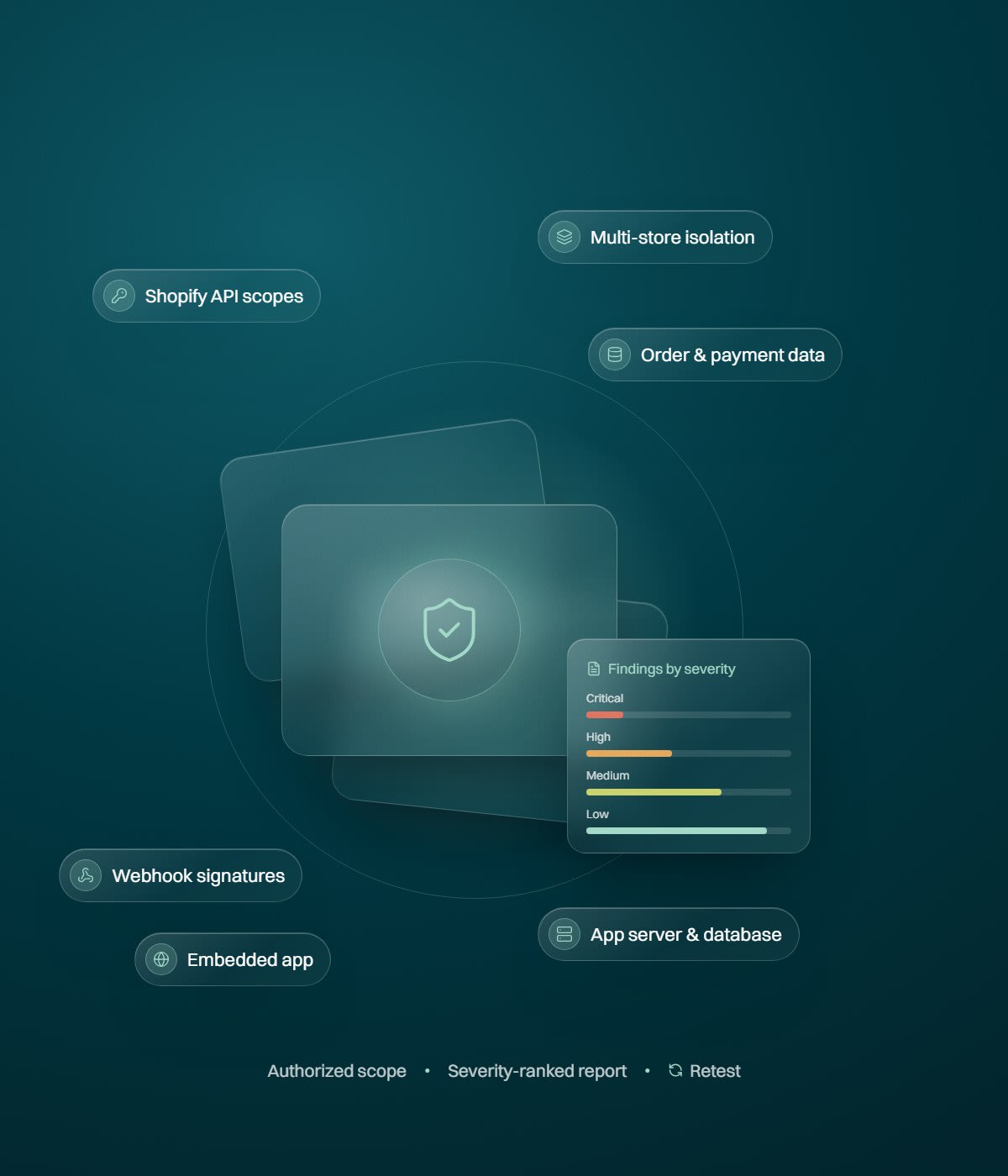
Authorized security testing for Shopify app developers, SaaS companies, agencies and technology providers.
Shopify app VAPT (vulnerability assessment and penetration testing) is authorized security testing of a Shopify app, its APIs, webhooks and connected stores. Tizora checks how the app uses Shopify API access, keeps each store's data isolated and handles order, customer and payment data, then reports findings by severity and retests fixes.
One vulnerability in a Shopify app can reach more than one merchant
A Shopify app may connect to multiple stores and exchange sensitive order, customer and transaction information.
A vulnerability in the app or its integrations can expose data or affect more than one merchant. We find those risks before someone else does.
What we assess
What our Shopify app VAPT covers
We test the parts of a Shopify app where access, data and events cross boundaries: Shopify's APIs, the stores you connect to, your backend and your embedded app.
Shopify API security
We review how your app connects to Shopify and uses its APIs.
- API authentication, authorization and access controls
- Requested API scopes and whether they match the app's needs
- Protection of API credentials and tokens
- API request and response handling
- Error handling and rate-limit behavior
- Access to data and actions beyond the app's intended permissions
Order, customer and transaction data
We assess how information moves between Shopify, your app and connected services.
- Access to order and customer information
- Transaction and payment-related data exchange
- Data protection in transit, storage and application logs
- Authorization checks when users request or update records
- Data retention and deletion practices
- Risks of exposing one merchant's data to another
Multi-store security
For apps connected to multiple Shopify stores, we check whether each store's information and credentials remain isolated.
- Store-level access controls and data separation
- Correct association of API credentials with each store
- Isolation of customer, order and transaction records
- Protection against cross-store data access
- Store installation, removal and authorization flows
Webhooks and event processing
We review how the app receives and processes Shopify events.
- Webhook authenticity and signature validation
- Duplicate, delayed or unexpected event handling
- Order, customer and payment event processing
- Authorization before making changes based on an event
- Sensitive information in webhook payloads, logs and error messages
App server and database
We assess the application's backend and data-storage components.
- Authentication, authorization and session handling
- API endpoint security and access controls
- Input validation and injection risks
- Database permissions and query handling
- Server configuration and exposed services
- Sensitive data storage and logging
Frontend and embedded app
We review the app's browser-facing code and Shopify embedded experience.
- Cross-site scripting and unsafe rendering
- Client-side secrets or sensitive data exposure
- Session and redirect behavior
- Frontend-to-backend authorization
- Browser security controls and unsafe input handling
We review how your app connects to Shopify and uses its APIs.
- API authentication, authorization and access controls
- Requested API scopes and whether they match the app's needs
- Protection of API credentials and tokens
- API request and response handling
- Error handling and rate-limit behavior
- Access to data and actions beyond the app's intended permissions
Payment and transaction flows, tested safely
If your app integrates with a payment gateway or processes payment-related events, we assess the agreed integration flows: configuration and boundaries, transaction status and event validation, webhook handling for payment events, protection of payment-related information, and risks from trusting unverified client-side or third-party data.
Payment testing is planned around authorized test environments and workflows. Live transactions are not part of testing unless specifically agreed in writing.
How the assessment works
Scope and authorization
We agree on the app, environments, connected stores, APIs, integrations, test accounts and testing boundaries. Testing begins after written authorization and scope are in place.
Architecture and data-flow review
We map the app's main components and how information moves between Shopify, your app, databases, storefront code and third-party services.
Security testing
We test the agreed areas using controlled methods. Testing is planned to reduce the chance of disruption to stores, customers or transactions.
Findings and recommendations
You receive a report that describes each issue, its impact, supporting evidence and practical remediation guidance.
Review and retest
After your team addresses the findings, we can retest the agreed issues and provide an update on the results.
What you receive
A report your leadership can act on and your developers can work from, focused on the risks specific to Shopify apps.
Executive summary
A plain-language overview of the results for decision-makers.
Technical findings ranked by severity
Each issue rated so your team knows what to fix first.
Evidence and reproduction details
Proof and steps to reproduce every confirmed issue.
Recommended remediation steps
Practical guidance your developers can follow.
Shopify-specific risk notes
Notes on relevant Shopify API, store-isolation and data-flow risks.
Optional retest summary
Confirmation of which agreed issues have been resolved.
How we work
How we keep testing safe for your stores
Every engagement follows the same ground rules, agreed before testing starts.
Written authorization first
Testing starts with written authorization and an agreed scope.
Careful data handling
Store, customer, order and transaction data are handled carefully.
Minimal impact on live stores
Testing is designed to minimize impact on live stores.
No surprises in production
Production changes and live transaction testing require explicit agreement.
Confidential findings
Findings and supporting evidence are handled confidentially.
Critical issues reported promptly
If a critical issue is discovered, we tell you right away.
Who this Shopify app security assessment is for
This assessment is suited to teams whose Shopify app touches more than one store, or handles order, customer or payment data.
- Teams that build or maintain Shopify apps
- Apps connected to multiple Shopify stores
- Apps that use Shopify APIs to access order or customer information
- Apps that process or exchange transaction and payment-related events
- Teams reviewing an app before launch, after a major update, or as part of ongoing security work

About Tizora
Security testing from a team that builds on Shopify
Tizora is a product engineering company with more than 100 developers, engineers and technology specialists, working from Princeton, New Jersey and Ahmedabad, India. Our assessments focus on API access, store isolation, sensitive data exchange and practical remediation.
Our own Shopify app
ReCom AI, our AI sales agent, helps shoppers discover, engage and buy on Shopify stores.
ReCom AIShopify and Magento integrations
Storefront and mobile app orders connected straight to warehouse robots.
CStore Master case studyShopify Plus features
An AI skin analysis feature added to a skincare brand's Shopify Plus store.
AI skin analysis case studyBeyond Shopify
Secure code review and web application and API penetration testing for any stack.
application security servicesFAQ
Shopify app VAPT FAQs
A Shopify app VAPT (vulnerability assessment and penetration testing) is authorized security testing of a Shopify app and its integrations. It checks Shopify API access and scopes, multi-store data isolation, webhooks, the app server and database, the embedded app and any payment integrations, and ends with a report of findings ranked by severity.
Yes. The scope can include store-level access controls, credential handling, and whether one store could access another store's data.
Yes. The assessment can review API authentication, requested scopes, authorization checks, and how the app handles data returned by Shopify.
Yes. Testing can cover access controls, data exchange, storage, logging, and whether records are correctly associated with the authorized store and user.
Yes. We can assess the agreed payment integration, transaction event handling and webhook flows. Testing uses authorized test workflows unless production testing is explicitly agreed.
Testing is planned to reduce risk. The scope identifies the environment and activities that are allowed before testing begins.
Usually, we need a description of the app and its integrations, the environments and stores in scope, suitable test accounts, and written authorization. Architecture or data-flow notes are helpful if available.
Yes. Retesting can confirm whether the agreed issues have been addressed.
The timeline depends on the app's complexity, the number of workflows, APIs and connected stores, the technology stack and the agreed scope. We provide an estimated timeline after reviewing your app and requirements.
Get started with a Shopify app security assessment
Tell us about your Shopify app, the stores it connects to, and the APIs or payment integrations you want assessed. We'll follow up to discuss scope, timing and the information needed to begin.
