AI Skin Analysis: Turning a Customer Selfie into Personalized Product Recommendations
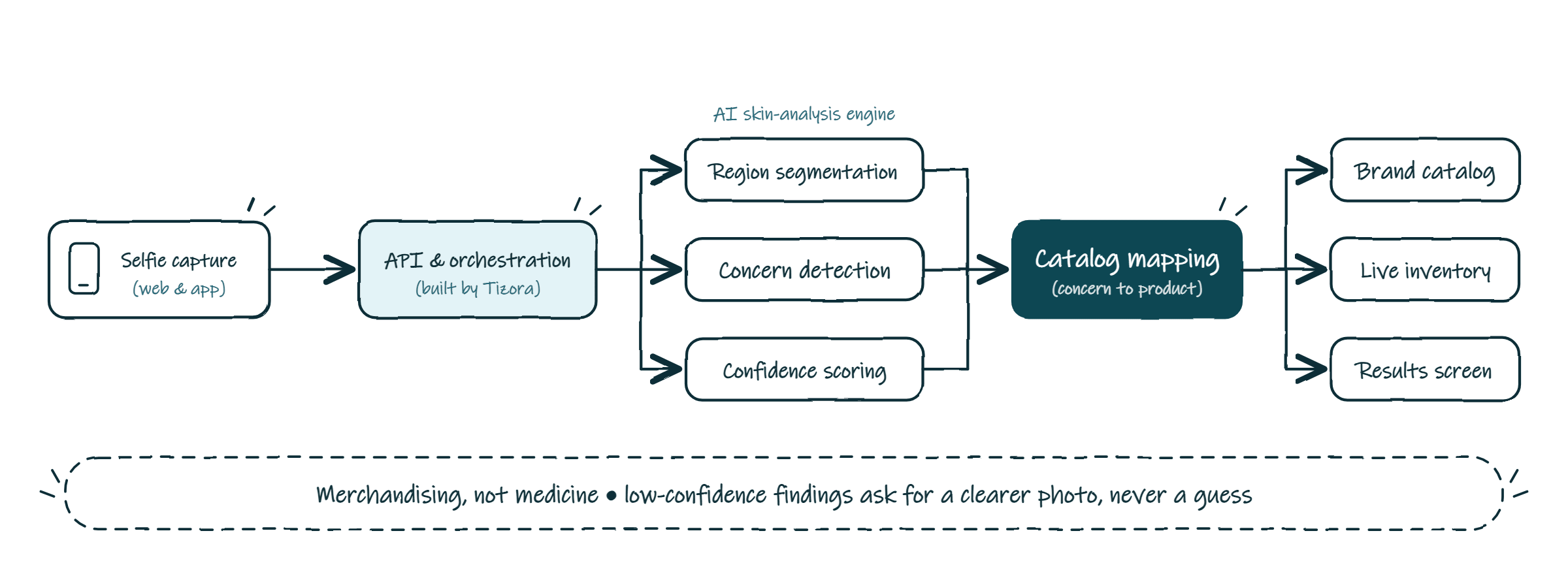
AI skin analysis lets a skincare shopper take one selfie and see products matched to the visible concerns it finds. Tizora built the feature as a seven-step pipeline: it segments the face, detects visible concerns, flags low-confidence reads and maps each finding to in-stock products in the brand's own catalog. It is a merchandising feature, not a medical diagnosis.


What the feature delivers
Why is skincare shopping online still a guessing game?
Most skincare storefronts show the same product grid to every visitor, whether they're dealing with dryness, breakouts, or nothing in particular. Generic quizzes ask people to describe concerns they may not have the vocabulary, or the mirror light, to judge accurately.
Brands needed a way to connect what a customer's skin actually looks like to what's already sitting in their catalog, without turning the customer into their own dermatologist first, much like our CStore Master work connects a storefront directly to what's actually in stock.
- Every visitor saw the same product grid, whatever their skin looked like
- Quizzes asked shoppers to judge concerns they may not have the vocabulary, or the mirror light, to assess
- Real selfies come from bathroom mirrors and front-facing cameras, not studio lighting
- A face photo is sensitive data, so its handling and retention had to be a deliberate decision

How does the AI skin analysis pipeline work?
From selfie to product recommendation in seven steps, inside the brand's own web or app storefront.
An engine that reads skin, then hands off to the catalog
The feature segments the face into the regions it's designed to assess, checks each region against the visible concerns it's built to recognise, and scores how confident it is in what it found.
High-confidence findings go straight to the concern-to-catalog mapping. Low-confidence findings are shown as such, or the customer is prompted for a clearer photo, instead of a guess dressed up as certainty. It's the same rule our AI license plate recognition layer follows: a result the system isn't sure of never becomes a decision.
Every result on screen pairs a visible finding with a product from the brand's own catalog, not a generic skincare-quiz outcome.
A layer that plugs into the brand's existing catalog and storefront, instead of replacing them.
What the feature does
A feature that reads real selfies, states its limits honestly, and always resolves to a real product.
Guided selfie flow
Framing and lighting guidance built into the capture step, designed for bathroom mirrors and front-facing cameras, not studio lighting.
- Lighting variance
- Angle & framing
- Retake guidance

Visible concern detection
Scans the face regions it's designed to assess for visible concerns such as redness, dryness, fine lines, dark spots or uneven tone.
- Region segmentation
- Concern detection
- Merchandising, not medicine
Confidence handling
Uncertain reads are flagged, not guessed. Poor lighting, angle or resolution prompts a retake instead of a result stated as fact.
- Confidence scoring
- Honest confidence
- Plain language

Catalog mapping
Every finding resolves to a real product through a defined rule set tied to the categories and attributes in the brand's catalog.
- Concern taxonomy
- Catalog attributes
- No dead ends

How does the feature fit into an existing storefront?
A layer that plugs into the brand's existing catalog and storefront, instead of replacing them.
Selfie capture (web & app)
A capture widget embedded in the brand's existing site or app, with framing and lighting guidance.
- Guided capture UI
- Web and app support
React
TypeScript
Selling skincare or beauty products online? See how a selfie-based skin analysis could connect to your own catalog.
Talk to our AI engineering team
Outcome: recommendations shaped by each customer's own selfie
We compared the live feature with the storefront's previous experience, where every visitor saw the same product grid. The first three rows describe how the feature behaves; the last two are indicative estimates.
| Metric | Before | to | After | Change |
|---|---|---|---|---|
| Product recommendations | Same grid for every visitor | Shaped by the customer's own selfie | Personalized | |
| Link between skin and suggestion | None | Every suggestion traces to a detected concern | No dead ends | |
| Uncertain reads | Wrong result stated as fact | Flagged, or a retake is prompted | Honest confidence | |
| Add-to-cart rate on recommended products | 3.0% | 3.6% | +20% | |
| Selfie to results screen | No selfie flow | Under 10 s | New capability |
How we measured
- Qualitative rows:
- behaviour of the live feature compared with the previous one-grid-for-every-visitor storefront.
- Indicative figures based on project estimates; to be replaced with measured client data.
A skin-analysis feature only earns its place in a storefront if it's honest about what it can and can't tell a customer. We built ours to say what it can see, and what it would suggest, nothing dressed up as a diagnosis.
Lessons
What we learned
Check image quality before analysis
Selfies aren't lab photos. Assessing quality first, then applying the fix each image needs, beat one process for every photo.
Every finding needs a product
No dead ends: a detected concern always resolves to something in the brand's catalog.
Treat the selfie as sensitive data
Selfie handling and retention are a deliberate decision agreed with the brand, not an afterthought.
Will this work for your store?
Who it's built for and what it needs to plug in.
- Built for
- Skincare and beauty brands selling through their own web or app storefront
- Prerequisites
- API access to the storefront, and a catalog with product categories and attributes to map concerns to
- Scope
- Visible-concern merchandising, not medical diagnosis, with selfie handling agreed up front
This approach fits skincare and beauty e-commerce brands that want a customer selfie to lead straight to products in their own catalog, without replacing their existing storefront.

AI skin analysis FAQs
Frequently asked questions
AI skin analysis, also called an AI face scan, is an e-commerce feature that reads a customer's selfie, identifies the visible skin concerns it's designed to recognise, and connects those findings to relevant products in the brand's catalog.
No. It flags visible concerns for merchandising purposes, to guide a customer toward relevant products, and is not built or positioned as a medical diagnostic tool. Anything resembling a medical claim is deliberately kept out of scope.
Each concern the model can detect is mapped, through a defined rule set, to product categories and attributes already in the brand's catalog, so every finding resolves to a real, purchasable product rather than a generic suggestion.
Yes. The feature is designed to sit ahead of a brand's existing storefront and product catalog through an API layer, so recommendations stay current as the catalog changes, without requiring a separate platform.
Selfie handling and retention are treated as a deliberate design decision, not an afterthought, since a face photo is sensitive data; the specifics are agreed with each brand as part of the integration.
Disclosure
Results reflect this implementation's data and will vary.
Some figures are indicative estimates pending measured client data.
AI skin analysis is a cosmetic recommendation feature, not a medical diagnosis.
Related case studies
A selfie became a shortcut to the right product.
AI Skin Analysis turns a moment of uncertainty in the storefront into a personalized answer grounded in the brand's own catalog.
