AI for airport operations that flags turnaround delay risk earlier
A decision layer on top of your AODB and A-CDM. It tracks every turnaround, flags delay risk and stand conflicts early, and explains each recommendation. Your teams make the final call.

Tizora provides AI for airport operations: a decision layer that sits on top of your existing airport management system, such as the airport operational database (AODB) and A-CDM. In a 12-week pilot at a mid-size European airport, it flagged turnaround delay risk about 18 minutes earlier and raised on-time departures within 15 minutes from 78% to 85%.
Results from a 12-week airport pilot
Mid-size European airport, 14 contact and 6 remote stands, April to June 2026 compared with January to March 2026. Results reflect this pilot only. See the full pilot results
Airport operations management software built around how the day runs
Tizora's airport operations software is built around how airports and airlines actually run, hour by hour.

Airport operations
- Airport operations and airport control centres
- Gate, stand, and remote-bay management
Airport operations
Tizora brings operational data, procedures and real-time events together for airport operations and control centres.
Teams see the context behind gate, stand and remote-bay decisions as the day changes.

Airline operations (in development)
- Airline operations and flight disruptions
- On-time performance and operational compliance
Airline operations (in development)
In development: Tizora is building support for airline operations teams to stay aware of flight disruptions as they develop.
On-time performance and operational compliance stay in view, with answers traceable to the source.

Turnaround and ground handling
- Aircraft turnaround coordination
- Ground handling coordination
Turnaround and ground handling
A turnaround management system view of every flight, with each ground task tracked against plan.
Tizora supports aircraft turnaround and ground handling coordination with clear status.
Ground teams get the procedures that apply, without searching across systems and inboxes.
Why are turnaround delays hard to predict?
Information is spread across flight systems, turnaround plans, SOPs, emails, and operational teams.
Delays and resource conflicts change throughout the day.
Decisions need to be timely, explainable, and aligned with airport rules.
At the pilot airport, about 1 in 6 ground-task timestamps were missing or late, so the software infers the gaps and flags them as estimated rather than hiding them.
How AI for airport operations turns scattered data into decisions
One layer that connects what your teams already have and puts the right context in front of them.
Connects operational systems and aviation documents
Flight systems, turnaround plans, SOPs and operational data brought into one place.
Makes SOPs and airport rules easy to access
Procedures and rules found in seconds, not searched for across inboxes and folders.
Highlights operational risks and exceptions
Delays and resource conflicts surfaced as they develop.
AI-assisted recommendations with the relevant context
Suggested actions that arrive together with the information behind them.
Preserves traceability to source data and procedures
Every answer can be followed back to the data and procedure it came from.

What our airport operations software covers

Designed for aviation operations teams
Who uses AI for airport operations?
Airport operations control centre (AOCC)
A shared view of live airport operations.
Airport duty managers
The information needed to make timely operational calls.
Gate and stand planners
Visibility of gate and stand occupancy and conflicts.
Airline Operations Control Centre
Awareness of disruptions and their downstream effects.
Ground-handling supervisors
Clear turnaround status and the procedures that apply.
Station operations teams
Quick access to rules, procedures and source data.
Does the AI make operational decisions on its own?
- Role-based access to operational information
- Source-linked and explainable AI responses
- Version-controlled procedures and documents
- Audit-friendly decision history (how we test AI systems)
- Integration with existing operational systems
No. Tizora suggests and explains; people decide. Every recommendation shows the rule and data behind it, and every decision is kept in an audit-friendly history.
How it works with your AODB and A-CDM
Tizora does not replace your AODB, A-CDM process or airport resource management system (RMS). It reads from them and adds risk scoring and recommendations on top.
Airport management software vs A-CDM vs an AI decision layer
| Question | Airport management software (AODB, RMS) | A-CDM | Tizora's AI decision layer |
|---|---|---|---|
| What it is | The airport's system of record for flights, resources and planning | A shared process and set of milestones for airport partners to exchange turnaround timing | Software that reads from both and scores turnaround delay risk |
| Main job | Plan and record the day: schedules, gates, stands, staff | Give everyone the same target off-block and start-up times | Warn early about delays and stand conflicts, and explain why |
| Who decides | Planners and duty managers | Airport, airlines, ground handlers and ATC together | People. It suggests and explains; it never acts on its own |
| Replaces the others? | No | No | No. It sits on top of both |
Featured pilot: turnaround and aircraft parking
Over a 12-week pilot on 14 contact and 6 remote stands at a mid-size European airport, Tizora tracked every turnaround, flagged delay risk and stand conflicts early, and suggested parking positions with the rule behind each one. Results are in the proof strip above.

Free guide: Seeing Turnaround Delays Before They Happen
Case studies
Aviation case studies
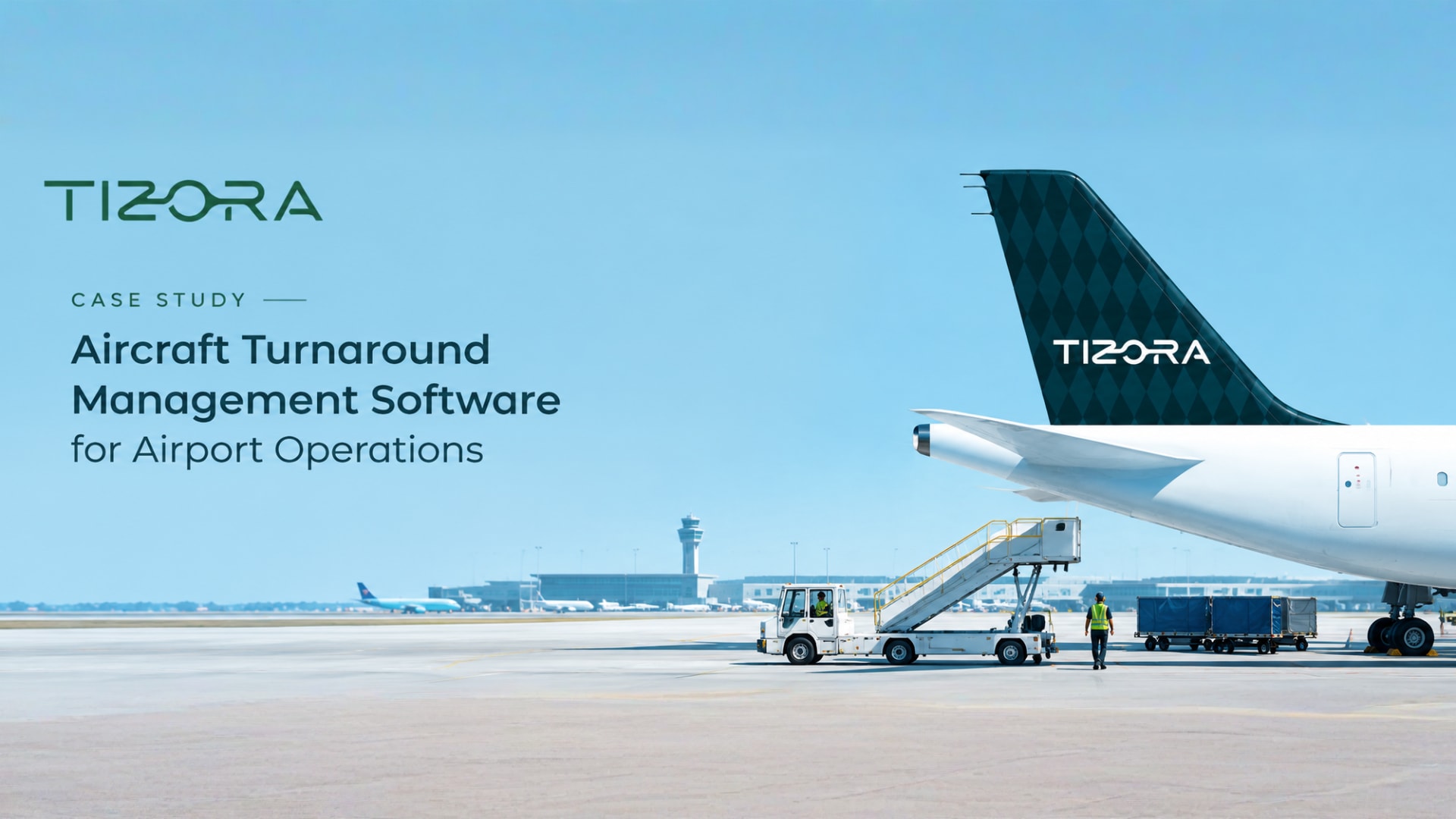
Aircraft Turnaround Management Software
FAQ
AI for airport operations FAQs
It is software that uses operational data, procedures and real-time events to help airport teams spot risks and make decisions sooner. Tizora's version is a decision layer on top of existing systems such as the AODB and A-CDM that tracks turnarounds, flags delay risk and stand conflicts, and explains each recommendation.
Airport operations software helps airport teams plan and run the day: flights, turnarounds, gates, stands and ground resources. Core systems such as the AODB and the resource management system hold the plan. Tizora adds an AI layer on top that tracks each turnaround, scores delay risk and suggests stand changes, with the rule and data behind every suggestion.
Airport management software usually covers an airport's core records and planning, such as the AODB, resource allocation and billing. Tizora does not replace it. It reads from those systems and adds turnaround delay-risk scoring, stand-conflict warnings and source-linked answers from your SOPs, so teams can act earlier.
It builds one record per flight, tracks each turnaround task against plan, and scores delay risk as the turnaround progresses. In a 12-week pilot at a mid-size European airport, delay-risk warnings arrived on average about 22 minutes before off-block, compared with about 4 minutes before.
Not quite. Flight delay prediction usually forecasts whether a flight will depart late from schedules, weather and network data. Tizora scores delay risk during the turnaround itself, from ground-task progress against plan, so stand and ground teams can act before off-block. Network-level flight-disruption intelligence for airline operations is in development.
No. Tizora sits on top of your existing airport systems and reads from them. It adds delay-risk scoring, stand-conflict warnings and recommendations without replacing the airport operational database (AODB), the A-CDM process or the airport resource management system.
No. It suggests parking positions and actions with the rule behind each one, and people make every final decision. Each decision is kept in an audit-friendly history.
Over 12 weeks on 14 contact and 6 remote stands, on-time departures within 15 minutes rose from 78% to 85%, turnaround-caused delay minutes fell 22% and last-minute stand changes fell 41%, compared with the previous quarter. Results reflect this pilot only.
Airport Operations Control Centres, airport duty managers, gate and stand planners, Airline Operations Control Centres, ground-handling supervisors, and station operations teams.
Yes. Tizora preserves traceability to source data and procedures, gives source-linked and explainable AI responses, and keeps an audit-friendly decision history.
Through role-based access to operational information and version-controlled procedures and documents, with integration into your existing operational systems.
Bring AI for airport operations to your stands
Start with a focused pilot on a set of stands, like the one in our case study. We connect to your existing systems, measure against your own baseline, and you decide what happens next. As an aviation software development company, we also build custom aviation software solutions for airport and airline operations teams.
