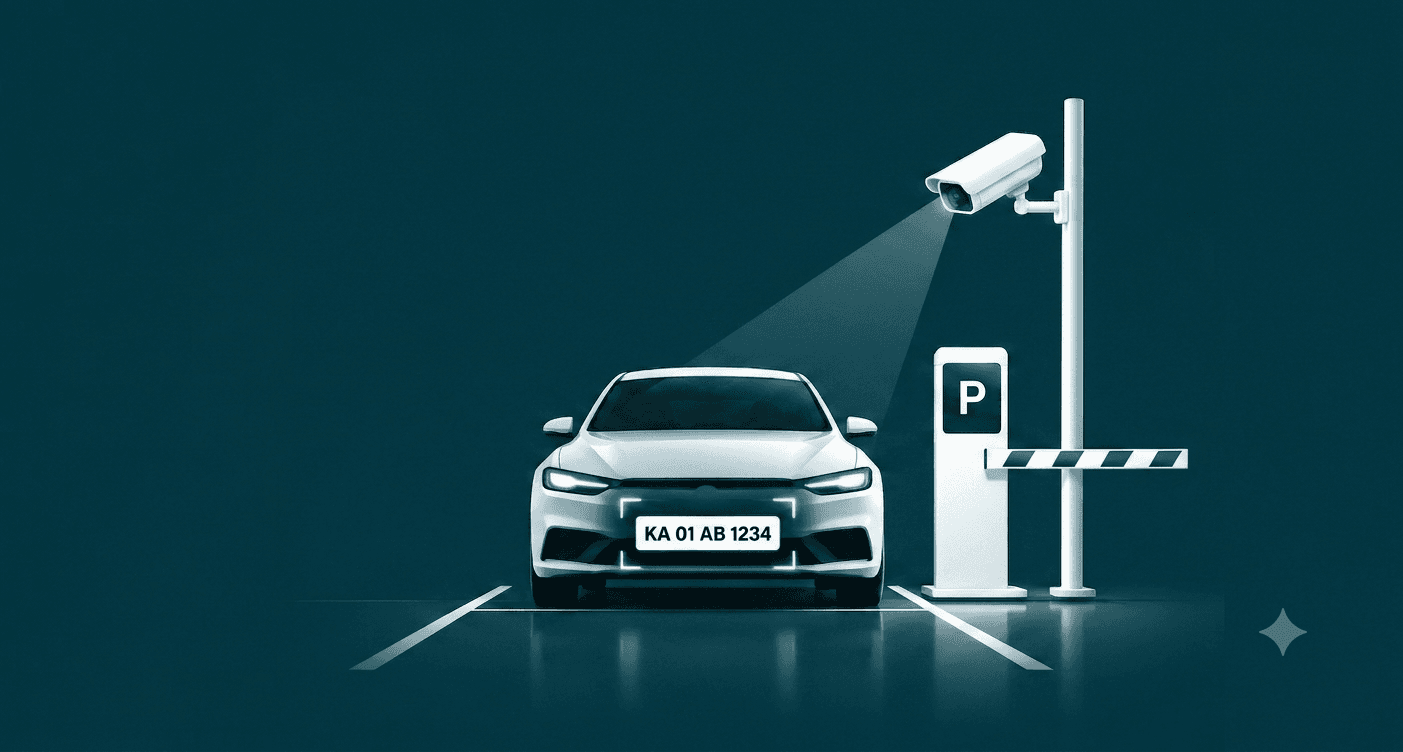
How Does That Camera Actually Read Your License Plate?
You drive past a small camera at a parking garage or toll booth and the gate just opens — no ticket, no human, nothing. Here’s a plain-English walkthrough of what that camera is actually doing, one step at a time.

You’ve probably had this moment: you drive up to a parking garage, or through an open-road toll lane, and there’s no ticket machine, no attendant, sometimes not even a barrier arm. Just a small camera on a pole. A second later, the gate lifts, or you get a bill in the mail a week later. Somehow, that camera knew exactly which car just drove through — and it did it by reading your license plate, automatically, in the time it takes you to blink.
This is called license plate recognition, or LPR for short (in the UK and Europe, you’ll often hear it called ANPR — automatic number plate recognition — same idea, different name). It sounds simple when you say it out loud: "a camera reads your plate." But if you’ve ever tried to photograph a license plate yourself at night, or in the rain, or from a moving car, you already know that’s a lot harder than it sounds. So how does a machine actually pull it off, reliably, thousands of times a day, in a random parking lot?
That’s what this post is actually about — not the buzzwords, just a plain walkthrough of what happens between "camera sees a car" and "gate opens," written for someone who has never written a line of code and never wants to.
Step 1: Finding the plate in the picture
The camera doesn’t know, out of the box, that a car is even in front of it — it just sees a picture, the same way your phone camera sees a picture. The first job of the software is figuring out: is there a vehicle in this frame at all, and if so, where exactly is the license plate on it? This is the same basic skill your phone uses when it draws a little box around a face before taking a photo. The computer has essentially been shown millions of example pictures of vehicles and plates until it gets good at recognizing the pattern — a bright, roughly rectangular strip of characters, usually near the front or back bumper.
Once it’s confident there’s a plate somewhere in the picture, it draws an imaginary box around just that part and effectively crops the photo down to it — throwing away the rest of the car, the road, the background. From here on, the system is only working with a small, zoomed-in rectangle: just the plate.
Step 2: Cleaning up a messy photo
This is the step most people never think about, and it’s honestly where most of the real engineering effort goes. A plate photographed on a bright, sunny afternoon, straight-on, is easy. A plate photographed at 11 p.m. in the rain, at a slight angle, with a headlight glaring off the metal, looks completely different — and that second scenario is what actually happens most of the time in the real world.
So before the system even tries to read the characters, it checks: is this image good enough to read as-is, or does it need help? If the picture is blurry because the car was moving, it tries to sharpen it. If there’s glare, it tries to reduce it. If it’s dim, it brightens it. Think of it like the auto-enhance button on your phone’s photo app, except it’s specifically trained to fix the exact problems that make license plates hard to read: motion blur, glare, mud, snow, and low light.
Step 3: Actually reading the letters and numbers
Now comes the part that sounds like the whole job but is really just one step: turning that cleaned-up little image of a plate into actual text, like "7ABC123". This is done by a technology called OCR — optical character recognition — which is the same basic idea used by apps that scan a printed page and turn it into editable text you can copy and paste. The system has learned what letters and numbers look like in the fonts and layouts used on license plates, which actually vary quite a bit: different states, different countries, and even different plate types (a commercial truck plate looks nothing like a regular passenger car plate in most places) all use different styles.
The system reads each character one at a time, left to right, and stitches them together into the final plate number — the same way you’d read it yourself if you were squinting at a photo.
Step 4: Double-checking its own work
Here’s a detail that separates a good system from a sloppy one: after it reads a plate, it doesn’t just blindly trust itself. It calculates something like a confidence score — basically, "how sure am I that I read this correctly?" If the photo was clean and the characters were obvious, that confidence is high, and the system moves on immediately. If the photo was messy — muddy, blurry, half-covered by a decorative frame — the confidence is lower, and a well-built system won’t just guess. It might take another photo, try a different angle, or flag the read for a person to double-check later, rather than confidently reporting a plate number that might be wrong.
This one habit — knowing when it doesn’t know — is a big part of what makes the difference between a system that works great in a demo video and one that can actually be trusted to run a parking garage every day, in every kind of weather, without a human standing there fixing its mistakes.
Step 5: Doing something useful with the answer
Reading the plate is only half the story — what happens next depends entirely on where the camera is installed. At a parking garage, the plate number gets checked against a list of valid permits or paid tickets in under a second, and the gate opens if there’s a match. At an open-road toll gantry, the plate gets matched to a billing account so a bill can go out later. At a police checkpoint, it might get checked against a database of stolen vehicles or active alerts. The camera and the reading process are largely the same everywhere — it’s the decision made afterward that’s completely different depending on the job.
Why it sometimes gets it wrong
If you’ve ever had a parking app charge you for the wrong amount of time, or needed to show a receipt because the gate didn’t recognize your plate, you’ve met one of LPR’s real limits. Snow or road salt can cover half the characters. A dealership frame can block the state name. A plate that got bent in a minor fender-bender reads differently than a flat one. Headlights at night can wash out the image entirely. None of these are exotic edge cases — they’re just Tuesday for a camera sitting outside in the real world, which is exactly why the "cleaning up a messy photo" and "double-checking its own work" steps above matter so much. A system that only works on perfect, textbook-clean plates isn’t actually useful anywhere outside of a demo.
A quick, honest word on privacy
It’s a completely reasonable thing to wonder about: a camera is photographing something that identifies your car, and by extension often you. A single camera reading plates at one garage is a fairly narrow thing. A whole network of cameras across a city, logging timestamps and locations over time, is a different kind of thing, and it deserves to be treated carefully. The systems that handle this responsibly tend to do a few specific things: they keep raw images only as long as they actually need to for the job at hand, they don’t casually mix "is this plate allowed in" logic with broader location-tracking databases, and they’re upfront about what’s being captured and why. It’s a fair thing to ask about any system you encounter, not a paranoid one.
Where this shows up in everyday life
- —Parking garages and lots: matching your plate to a paid ticket or a monthly permit so the gate can open without a ticket machine.
- —Highway tolls: reading your plate as a backup when a car doesn’t have a working toll transponder, so a bill can be mailed later.
- —Police patrol cars: automatically checking plates against stolen-vehicle and alert lists while an officer drives, without them having to type anything in.
- —Gated communities: letting residents’ cars in automatically while keeping a log of visitor vehicles at the front gate.
- —Rental car returns and delivery yards: quickly confirming which vehicle just pulled in without anyone walking up to check.
We’ve built exactly this kind of system ourselves — an AI-powered license plate recognition layer for a parking enforcement app, where officers scan plates from their phones and the system has to cope with snow, mud, glare, and every other messy real-world condition described above. If you’re curious what that looks like end to end, from the camera all the way to the enforcement decision, we wrote it up in our AI-Enhanced LPR Parking Enforcement case study.
Frequently asked questions
Is a real person looking at my license plate photo?
Usually, no — the entire process described above (finding the plate, cleaning up the image, reading the characters, checking the result) happens automatically without a human involved. A person typically only gets involved if the system isn’t confident about a read and flags it for manual review, which is a small minority of cases in a well-built system.
Can license plate cameras read plates in the dark or in bad weather?
Yes, though it’s harder. Most LPR cameras use infrared light (invisible to the human eye) to illuminate plates at night, since license plates are designed to reflect light back strongly. Rain, snow, and mud still make it harder, which is why systems include an image-cleanup step before trying to read the characters.
Does the system just store a photo of my car forever?
It depends entirely on who operates the system, but responsible implementations only keep raw images as long as they’re operationally needed — for example, until a parking session ends or a toll is billed — rather than indefinitely. This varies a lot between operators, so it’s a fair question to ask about any specific system you encounter.
How accurate is license plate recognition, really?
On a clean, well-lit, unobstructed plate, modern systems are very accurate — often above 95%. Accuracy drops with mud, snow, glare, motion blur, or damage, which is exactly why the image-cleanup and confidence-checking steps exist: to catch the harder cases rather than silently guessing wrong.
Is license plate recognition the same as facial recognition?
No — they’re different technologies solving different problems, though they share some underlying computer-vision techniques. License plate recognition reads a fixed sequence of printed characters on a plate; facial recognition tries to identify a person from their face, which is a different and more sensitive kind of problem.