Bringing banking anytime, anywhere, to every customer's pocket
Tizora built an API-first mobile banking platform for cooperative and commercial banks, connected directly to core deposits, loans and accounting. Customers get secure 24×7 access to balances, transfers, bill payments and service requests. Around 60% of routine transactions moved off branch and call-center channels, and every mobile action runs through the same core API as the branch.
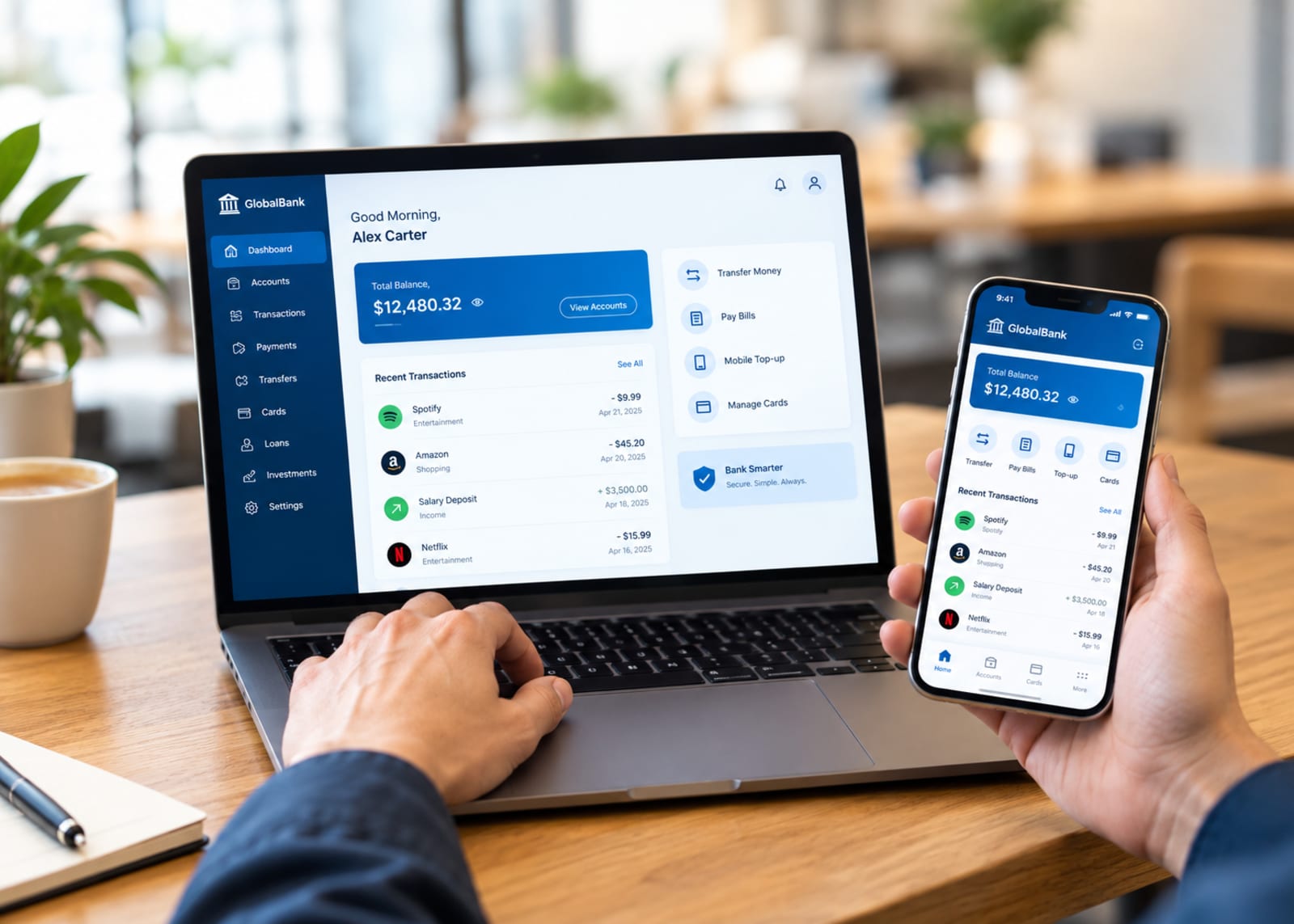
What changed when banking went mobile
What problem were branch-first banks facing?
Customers who can order groceries and transfer money to friends in seconds expect the same immediacy from their bank. When mobile access is missing or bolted on as an afterthought, institutions lose engagement and push routine transactions back onto already-stretched branch and call center staff.
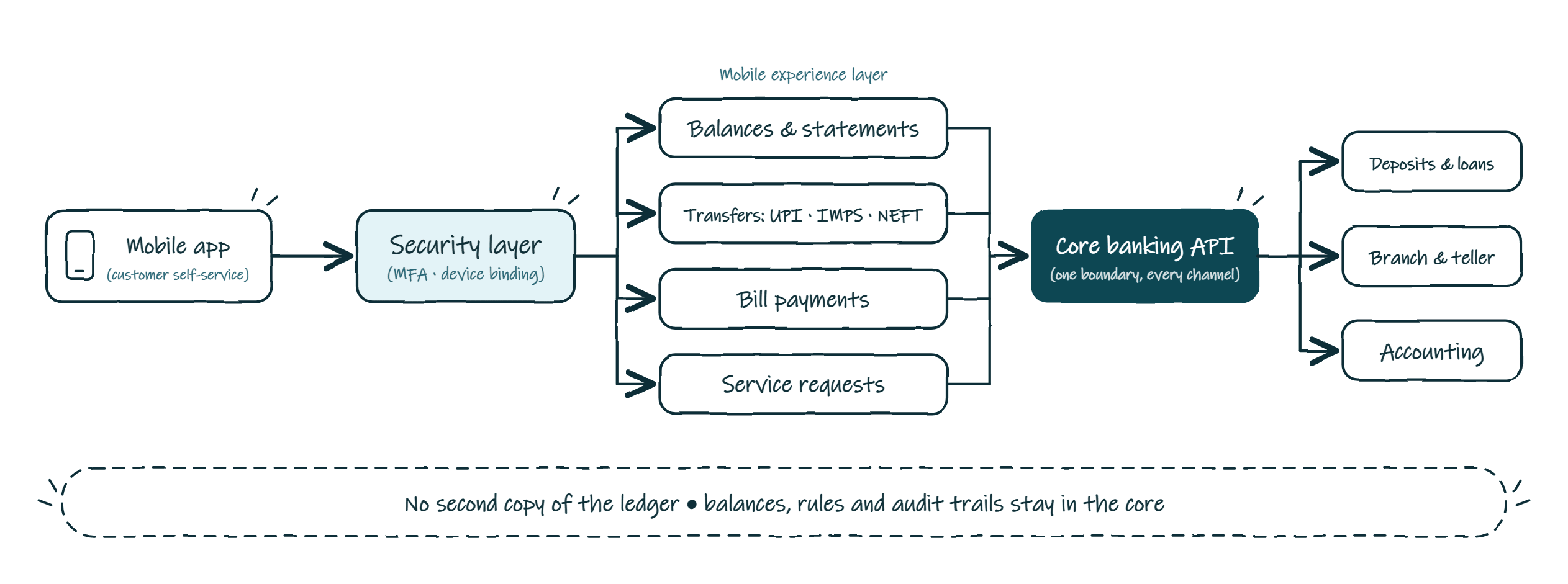
Building mobile banking on top of an existing core is not just a UI exercise. It requires secure authentication, real-time account and transaction data, and workflows for transfers, bill payments, and service requests that stay consistent with what happens at the branch or teller window.
The platform needed to give customers a trustworthy, always-available banking experience without duplicating business logic that already lived in the core, and without compromising on security or auditability.
- Routine balance, transfer and payment requests landing on stretched branch and call center staff
- Account and transaction logic that already lived in the core and could not be duplicated in an app
- Security and auditability that had to match what happens at the branch or teller window

How did Tizora build it?
We built the mobile app as an experience layer on top of the connected core, starting with the transactions customers request most and extending it in stages.
Map everyday transactions
Listed the balance, transfer, bill payment and service requests customers reach for most often.
Confirm the core banking APIs
Checked which core APIs already expose those transactions, so the app reuses core rules instead of copying them.
Build the secure experience layer
Added multi-factor authentication, device binding and session controls, then built enquiry, transfer, payment and service request flows on the core API.
Roll out and extend in stages
Released mobile access in stages as trust and adoption grew, with room to add capabilities such as digital KYC onboarding.
A mobile experience layer, not a second source of truth
We treated the mobile app as an experience layer over the core, never a parallel system holding its own copy of balances or transaction rules. Every request for a transfer, payment, or balance check flows through the same API boundary the core banking platform exposes to every channel.
That approach keeps account state consistent whether a customer transacts on mobile, at a branch, or through a teller, and it means new mobile features can ship without re-implementing financial logic. Security, validation, and audit trails stay centralized in the core, while the mobile layer focuses on a fast, intuitive customer experience.
The result is a mobile app that institutions can extend with new capabilities over time, such as digital KYC onboarding, without ever risking the integrity of the underlying banking data.
Everything customers need for everyday banking
From onboarding to daily transactions, Tizora's mobile banking platform covers the full spectrum of retail banking on mobile.
Digital account opening
Let customers open accounts from their phones in minutes. Paperless registration, eKYC, and document collection handled end-to-end.
- eSign and OCR-based document extraction
- In-app video KYC for full compliance
- Mobile and branch-assisted journeys

Real-time payments
UPI, IMPS, NEFT, and RTGS integrations let customers move money instantly. Configurable limits and approval layers keep risk in check.
- Intra-bank and interbank transfers
- QR-based UPI payments
- Scheduled and recurring transfers
- Utility bill payments, recharges and biller integrations

Self-service banking
Empower customers to manage their accounts without calling in. Statement requests, card controls and cheque book orders, all from their phone.
- Real-time balances, mini statements and transaction history
- Card block / unblock and limit setting
- Cheque book and statement requests
- Loan EMI schedules and payment tracking

Security and compliance
Security-first from the ground up. Every session, transaction, and data point is encrypted, audited, and compliant with regulatory guidelines.
- MFA with biometric and OTP options
- Role-based access and device binding
- Immutable audit logs and RBI alignment

What technology powers the platform?
Grouped by layer, from the customer's phone down to the core banking system.
App & services
Native apps and the API services behind them.
Kotlin (Android)
Swift (iOS)
Java
Spring Boot
PostgreSQL
Redis
Planning a mobile banking rollout? See how an API-first app fits on top of your core banking system.
Talk to our financial services team
Outcome: 60% of routine transactions moved to mobile
Routine banking moved to a self-service channel that stays in step with the core, so customers bank on their own schedule and branch staff handle fewer everyday requests.
| Metric | Before | to | After | Change |
|---|---|---|---|---|
| Routine transactions done on mobile (balance, transfer, payment) | 0% | 60% | +60 pts | |
| Hours banking services are available | Branch hours only | 24×7 | Always on | |
| Time to complete a fund transfer | About 20 min (branch visit) | Under 2 min (in app) | −90% | |
| Mobile actions validated by core banking rules | No mobile channel | 100% | One source of truth |
How we measured
- Indicative figures based on project estimates; to be replaced with measured client data.
Tizora gave us a mobile banking layer that our members actually trust—real-time balances, instant transfers, and service requests without a branch visit. It didn't require us to duplicate any of our core banking logic.

Lessons
What we learned
Keep one source of truth
Treating the app as an experience layer over the core kept balances consistent across mobile, branch and teller.
Reuse core rules, don't rebuild them
Routing every action through the core API let new mobile features ship without re-implementing financial logic.
Roll out in stages
Starting with the most-requested transactions and expanding as trust grows keeps each release small and easy to verify.
Will this work for your bank or NBFC?
Who it fits, what it connects to and how a rollout is usually scoped.
- Built for
- cooperative and urban co-op banks, small finance banks, commercial banks, NBFCs and fintech platforms
- Integrates with
- your core banking system through its API layer, plus UPI, IMPS, NEFT and RTGS
- Typical scope
- map the most-requested transactions, confirm core APIs, then roll out in stages
This approach fits institutions that want a secure mobile channel on top of an existing core banking system, without a rip-and-replace.
Mobile banking FAQs
Frequently asked questions
Mobile banking gives customers secure, self-service access to core banking services, such as balance enquiry, transfers, and bill payments, directly from a smartphone app.
A strong mobile banking platform typically covers secure customer access, account and balance enquiry, fund transfers, bill payments, service requests, and consistent behavior across other banking channels.
Mobile banking serves retail customers and members of cooperative and commercial banks who want everyday banking tasks handled without visiting a branch.
Mobile banking should connect through the same API layer the core banking platform exposes to every channel, so balances, transactions, and business rules stay consistent instead of being duplicated in the app.
A well-engineered mobile banking app relies on multi-factor authentication, device and session controls, and encrypted communication, with every transaction validated and audited by the same core banking rules used at the branch.
Most institutions start by mapping the transactions customers request most often, confirming the core banking APIs available for those transactions, and rolling out mobile access in stages as trust and adoption grow.
Disclosure
Client name withheld under a confidentiality agreement. Results reflect this client's data and will vary. Some figures are indicative estimates pending measured client data.
More fintech case studies
Give your customers banking that fits in their pocket.
Talk with Tizora about secure mobile access, connected core banking, and a rollout plan designed around your institution's customers.
